Sunday, August 21, 2005

(D) August 21, 2005 - En-Body-Men

Picture by TVSmith

WEIJUN of Wj Powerhouse expanded his solo work, EN-BODY-MAN, to a piece which involves an ensemble of six. A good move, since this adds colour and character to the contemporary dance, now called EN-BODY-MEN.

In the hour-long full-length production at the Kuala Lumpur Performing Arts Centre on Aug 18, Weijun, 27, proved that he might well be the embodiment of young Malaysian dancers and choreographers. To boot, he also composed the euphoric fusion music (pop, R&B, rock, jazz) for the dances.

Wearing street clothes and sneakers, contemporary dancers Eden Lim, Kiea Kuan Nam, Teresa Chian, Steve Goh and Loke Soh Kim burst onto the stage, which had the audience seated around it. Hip-hopping in a self-engrossed manner, they used the body as a means of expression. Life is so much more complicated these days and its pangs are eased through dance. The smiles on the dancers’ faces said, “Heck it. We're living life to the fullest.”

Moving into a circular position, they bent from the waist and let their fingers “run” along the floor and through thin air. And before they made their exit, they sidekicked and flung their limbs in all directions, as if unlocking and loosening their bodies.

Weijun, in red sneakers and torn jeans, hogged the red spotlight. This no-music solo section focused on the strength and grace of the body. There was more ballet and contemporary dance vocabulary in this part of the piece. With ease, he jumped and pirouetted, posed in what looked like a bird in mid-flight, and combined both staccato and fluid movements in his upper body.

There is a scene that allowed the dancers to show their individuality; each carried a personal item – tissue paper, pillow, jacket, lipstick, and an orange - and dressed in the attire of their choice. Eden made the stage her bed and “sleep-danced” away with near-impossible elbow stands, back bends, and front splits.

In an elegant voice-led segment, poetry became music. Teresa and Kuan Nam took turns to recite the verses, in English and Mandarin, while the other dancers reacted to them.

In the male duet (Kuan Nam and Steve) that ensued, a different choreographic process took place. The dancers created their own movements using a form of contact improvisation technique. The last “touch” or movement of a dancer triggered the movement of another (dancer). Steve, who is duet-trained, took the opportunity to incorporate some “lifting” moments. Weijun joined them, but too briefly. Hopes for a male trio were dashed as he broke into another solo as the others left the stage.

Two couples, arms on each other’s shoulders, criss-crossed like grapevines onto stage.

In interspersing homo- and heterosexual pairing, the dancers played tug-of-war until Loke, the fifth dancer, entered and introduced imbalance and entanglement into the sequence. The music then broke down like a broken record and the bodies contorted to that.

Finally, the dance ended with the same hip hop sequence that it began with. As simple and straightforward as it looked, marrying hip hop and contemporary dance, if not done properly, could have disastrous results.Their union in EN-BODY-MEN was smooth, giving birth to what Weijun called a “pop contemporary dance”.

Thursday, August 18, 2005

(D) August 14, 2005 - Scream - A Response to Munch


A PICTURE paints a thousand words (and movements). But can the same be said of the reverse?

Anthony Meh’s Scream – A Response to Munch is a contemporary response to The Scream, by Norwegian artist Edvard Munch (1863-1944). In Munch's Post-Impressionist work, the central figure appears to be locked in a state of terror. The silent scream reverberates within the painting and out to the viewer.

Meh’s dance made its debut five years ago, and was presented again last week by Dua Space Dance Theatre at the Malaysian Tourism Centre in Kuala Lumpur. The 70-minute production combines dance and installation art, and modern and traditional aesthetics to express issues which the choreographer feels strongly about.

A huge rectangular patchwork of batik is spread on centre stage, awaiting the dancers. Aman Yap, as the urban character in black suit, makes his way from the main entrance while Tan Yau Kent and Justin Wong enter from either side of stage to pick up the patchwork batik and form human frames for the artwork.

Tan and Wong wear “batik-looking” attire that complements their male physique. The outfits are made of orange and green stretchable fabric, sewn together into a short-sleeved and thigh-length bodysuit. Flower motifs are patched on. The costumes, designed by Akma Suriati Awang (costume designer for the movie Anna and the King) give the dance a local drape.

As the light switches on and off, the dancers play window-display mannequins with the patchwork batik. A different “display” appears each time the stage is lit. Finally, the urban character is seen stealing away with the artwork spilling out of a luggage he is carrying.

In the next scene, the focus is on a woman with a yellow Post-It on her forehead. The woman, trapped in the video projection, reacts in fear towards the dancers on stage who Post-It-assault her head. Consequently, with a head for notes, her image would have made a more relevant lead-on compared to the dumb-blond-and-snatch-thief drama that preceded the projected image of The Scream.

A physical portrayal of entrapment follows the video. Two dancers emerge briefly with two thick bamboos (held horizontally) stretching out several rows of metal clothesline that sun a laundry of yellow Post-Its. But when held vertically, the prop becomes a yellow wall. Meh, who also dances in this piece, darts in between the clothesline, unable to get out.

The build-up is slow and finally the “scream” gets louder. Meh combines modern dance and quasi Chinese Opera to make a statement against abuse of power. This part of the choreography features four dancers, one red Chinese dance fan, and a table.

Three dancers conspire against Meh so that he doesn’t get the fan, the object of desire. The three sit on the table, obviously a position of power, while Meh cringes below. The white table top, when adjusted to face the audience, reveals flower motifs that match the dancers’ costumes.

Moving forward, we see dancers in Afro wigs and bathing suits compete for towel space on a beach. The comical scene soon gives way to (video) images of destruction caused by the recent tsunami. The dance has a bouncy quality that matches the music. But it is not a happy piece. At least one dancer lies listless on the patchwork batik throughout this scene. The cloth is now a corpse wrap.

The piece becomes darker as Meh ponders on war, execution and death. The dance vocabulary is vigorous and aggressive. The dancers, with leaps and turns, conquer the whole stage as if claiming land.

Meh returns to the first scene where the urban character is stealing away from stage. The character is captured and defeated.

Insofar as the dance goes, Meh is able to paint pictures of what pains him. However, the involvement of installation artist Liew Teck Leong raises the question: at what point does set design, props, multimedia, and even lighting turn installation art? The point of differentiation and its place in this dance are not clear.

Friday, August 12, 2005

(D) August 12, 2005 - Penetrating the Rasa


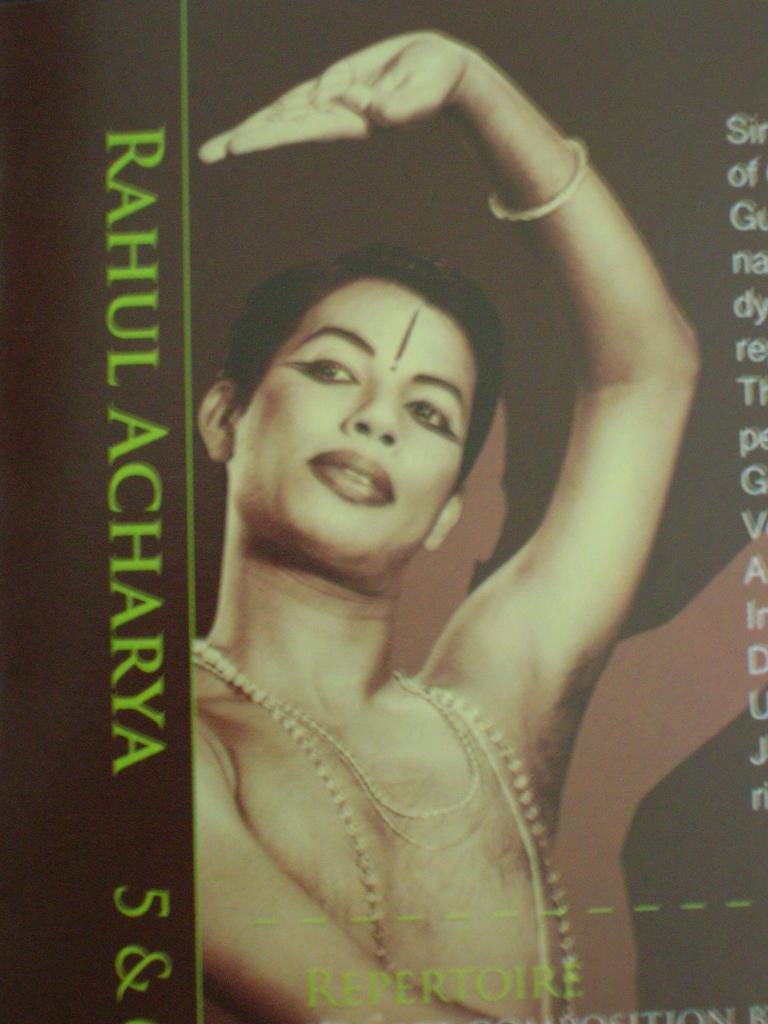
The haze in Kuala Lumpur hid all the stars but one. India-based Odissi dancer Rahul Acharya shimmered on Amphi-Sutra at Sutra Dance Theatre’s Under the Stars 2005: A Season of Odissi last week.

Rahul performed a six-part solo repertoire – Penetrating the Rasa – composed by Guru Shri Durga Charan Ranbir, an important guru of the school, or parampara, of the late Guru Deba Prasad Das.


In Mangalacharan Shiva Charanamrita, the invocatory piece, Rahul offers flowers to Bumi, or Mother Earth, and pays homage to Lord Siva.

Sthai is a forte of Deba Prasad Odissi dance where dancers emulate the classical dance sculptures in Orissan temples. This outstanding choreography keeps to the strict style of Guru Deba Prasad but incorporates a new concept.

Usually, a Sthai would begin with a chowka (square positions), but instead, this choreography begins with Pranata, a phangi (a style representing a sculpture).

The Pranata can be identified by the infolded hands (palms together). While keeping that gesture constant, Rahul dove and manoeuvred his hands and body like a slippery fish.

The other main phangis are: Alasa – the body stretches out in all directions emulating a lady trying to break her laziness; Manjira – the thumb and forefinger are locked holding imaginary cymbals, while the arms are in hitting and swirling motions playing the instrument; Mardala – this is the drummer’s position where palms face the ground and hands are flexed.

The chowka marks the change from one phangi to another, while the tribanga (three bends of head, torso and hip) brought the “moving” sculptures to live.


Rahul feels and enjoys every movement in his body as he morphs into various sculptures. The constant changing of body weight and coming back to centre almost seemed easy.

Oriya Abhinaya – E Ghora Barasa Kale and Abhinaya – Mamiyam Chalita Vilokya are both expressive dance interpreting literature. The former interprets the composition of poet, Kabi Samrat Upendra Bhanja. Two protagonists, Anukula Nayaka (hero) and Prositabhartruka Nayika (heroine), are separated and the nayaka imagines how his nayika would miss him. The latter is based on an excerpt from Gita Govinda by medieval Orissan poet Jayadeva. In this unique rendition, it is Krishna who feels the pain of separation from Radha. Krishna is remorseful of his wanton ways and causing grief to Radha.

A member of the audience later asked Rahul: “How convinced were you of Krishna’s love for Radha?” If the abhinaya did not convince, his answer certainly did!

“In Gita Govinda, Krishna is not as important as Radha. In fact, Krishna asks for the lotus dust on Radha’s feet so that he can rub it on his head” replied Rahul. “It is also destined that Krishna and Radha belong to each other eternally.”

The pure dance item, Pallavi – Raga Shankaravaranam/Arabhi, was executed with tenderness and grace. In contrast, the concluding piece, Sivashtaka, was dynamic and masculine.

There are seven classes of Tandava (masculine stylisation) and Rahul dances the Kalasava Tandava, which is the toughest of the seven. With heavy foot accents and fearsome expression, Rahul was Siva at his fiercest, destroying creation.

Insofar as being the hotbed of Odissi in Malaysia, Sutra Dance Theatre (
www.sutradancetheatre.com) has been successful in attracting and raising star-quality dancers.

Thursday, August 11, 2005

(R) Happy Birthday Break-a-Leg!


Happy birthday to me
Happy birthday to mee-eee
Happy birthday to me!

*clap**clap**clap**clap**clap**clap**clap**clap**clap**clap*

:)


***

Having a good fog may not be the best way to celebrate my birthday. Turning xx years old IS a state of emergency. The Government declared it so. I also confess to open burning - when I blew the candles, the API raised a few notch. I have to mask my disappointment when celebration plans have to be postponed. But well-wishes came on time, leaving me choking with emotion. Well, there's hope that the future won't be as hazy as today.

***

Tuesday, August 02, 2005

(D) August 2, 2005 - Dance Criticism in the Dance Ecology

(That's why we're critics!)


“Dance writing in Malaysian newspaper is deplorable.” Krishen Jit’s voice at the dance seminar held during MyDance Festival (MDF) 2003 still resonates in my head.

He did not proceed to say how it could be improved, but being the only journalist there, I did notice that my made-in-Malaysia MyThickSkin bullet proof vest was suffering severe damage.

Instead of one local speaker, a panel of three foreign speakers presented papers on dance criticism during the Asia Pacific International Dance Conference held during this years’ MDF. This time, journalists from more than five vernaculars attended the seminar, which is a marked improvement.

Since braving the bullets two years ago, I sought to improve writing through research, trial and error before I stumbled upon the Institute of Dance Criticism, a dance criticism fellowship held during the American Dance Festival (ADF). The gruelling 3 weeks was worth it. I learnt about dance criticism and more.


The Fellows wrote reviews twice a week. And then, peer and facilitator (10 people excluding me) would tear the piece (and our egos) apart. We attended movement and choreography classes to experience first-hand (and appreciate!) that dance and creating dance may not be as simple as it looks. We also had the opportunity to meet and interview choreographers, dancers, policy-makers, and other key figures involved in the development of dance.

A dancer would take years to hone his or her ability in one dance genre. The dance critic is expected to describe and comment on all genres from article one. The dance critic is thus a dance generalist and the onus is on him or her to continuously read, research, and yes, even dance! A dance background would be advantageous - though it does not guarantee that one would write better, it does train the eye to capture and read movements.

Dance is a movement language and the critic needs to translate this language into a written one. I liken it to painting fleeting images with words.

It is no surprise that few dare to venture into this area of writing. Unlike painting, literature and sculpture, dances do not “sit still” permitting the critic to scrutinize them leisurely. The literary critic can stop at will to re-read a difficult passage; the art critic can examine a painting from various distances or walk around a sculpture several times; the drama critic often has access to a text; and the music critic has access to a score.

The dance critic must make do with a burst of sensory impressions. The challenges are seeing the movement clearly, remembering what was seen, and finally, describing what was seen in a manner that will be comprehensible to the reader. Mastering note-taking in the dark is a bonus.

In a dance review, descriptions are important as one must not presume that everyone has watched the work. Description is valuable because it establishes the reality of the dance, lending some degree of permanence to an otherwise elusive and ephemeral event. The cruel paradox is that the critic is doomed to lose the reader in a literal, moment-to-moment account of what strikes the eye and ear. So, to keep the reader’s interest, the critic needs to interpret the work and also discuss the issues that it raises - all that within 500 to 800 words. Performances are often at night and editorial deadlines can be as soon as noon the next day.

A review must be constructive and not destructive. Justification must be made on why a work succeeds or fails. For example, Niluksi Koswanage’s Compelling, Complicated Debut (17 July 2005, The Star) and Antares’ No Silk Purse (http://www.kakiseni.com/articles/reviews/MDcwOA.html)
are both well-written negative reviews. Comments on these reviews are good indicators that Malaysians are thinking and talking about dance.

The tone should be encouraging and not demeaning. One should not intimidate emerging talents nor destroy an artists' career. Some critics show off how witty or how well they write at the expense of the artists. Some serve to pass judgement as though they are the Almighty Critic who has descended upon the Holy Theatre. As it is, there are only a handful of dancers in Malaysia. The work (the dance) and the cause (promoting dance) are more important than an inflated ego. At the same time, dance critics must also uphold their journalistic responsibilities by being honest to their readers who may be potential ticket-buying audiences.

Dance critics are like artists in some ways. Our works are subject to public scrutiny. And so, feedback from readers could also intimidate emerging writers or destroy a writers’ career. And most of us are struggling, impoverished freelancers driven only by passion for dance.

But dance criticism pieces are by far too few. There should be more than one voice on a piece of work. While there are plenty of previews, these do not count because it’s publicity driven. Dance needs to be documented and this cause is greater than self. Historians would one day reference such articles as sources of a periods’ social and cultural environment.

Dance critics are part of the dance ecology. They keep dance visible in the media. They form the vital link in educating and creating dance audiences, which in turn would help drive demand for dance and dancers; and hopefully attract more sponsors to fund dance projects.

Should dance academics write? Sure. But, a dance academic’s first love is to research and to develop knowledge. Professor Dr. Mohd Anis Md Nor (Professor of Ethnomusicology and Ethnochoreology, University Malaya) attests this. Should dancers write? Sure. But a dancer’s first love is to choreograph; to dance. The desire to move, to dance, is entrenched in the the dancer.

Cliché as it sounds, I was a fallen dancer. One back surgery, months of physiotherapy, and packets of pain killers and nerve vitamins later, I’m back dancing. But this time, I poise my pen and “tap” on my keyboard.

Thursday, July 14, 2005

(D) July 13, 2005 - (ADF) Battleworks Dance Company

Assignment: Battleworks Dance Company
Deadline: 13 July 2005
Venue: Reynolds Industries Theater, American Dance Festival
Date: 11 July 2005
Title(s): Alleluia (2002); Strange Humors (1998); Two (1994); Communion (world premiere); Unfold (2005); Takademe (1998); The Hunt (2001)


Essay: Becoming Dancer, Choreographer and Teacher


Dear Ms Houlihan,

I’m done with Julliard. I always knew I would graduate! That said I am at once excited and anxious about my future. Will a dance company take me? What if others out there are better than me? Can I afford to pay bills? I’ve so many questions. Will you pray for me?

Your faithful student,
Robert (Dancer)

Robert Battle, founder of Battleworks Dance Company clearly understands that it is the deep religious fervor for the art form that drives dancers. At the Reynolds Industries Theatre, American Dance Festival, his company kicked off the seven-item program with Alleluia (2002). The dancers, dressed in pure white, flapped their hands like wings of angels, crossed their hands to form a crucifix, and lifted their hands in worship and thanksgiving to God. The life of a professional dancer can be unpredictable and hard. Income and benefits fluctuate. But poet Robert Frost described it well when he wrote, “Two roads diverged in a wood, and I -- I took the one less traveled by, and that has made all the difference.”

Dear Ms Houlihan,

I used to do a lot of dancing and very little choreography – now it’s the reverse. I miss my “primadonna-ship” but at least I have more control over what I want to do now! I love the process of discovery and making things happen. I hope my dancers understand me. It’s so frustrating when they don’t.

Your faithful student,
Robert (Choreographer)

Mature dancers want to find their own voice and realise their ideas and visions. This exciting period is marked with experiments. Over the years, Battle explored large groups (The Hunt, Communion), duets (Strange Humours, Two, Unfold), humour (Two), technique (Strange Humour), narrative (Communion), music (Alleluia, Two) and so on. And Battle has yet to cease.

Dear Ms Houlihan,

Did you see me on stage? It’s obvious I can no longer dance the way I used to. Age has crept up on me. More importantly, did you see my babies on stage? My priorities have changed. I think it’s important to teach the young everything I know. I am burdened to make America dance, just as you did. The audience gave us thunderous applause. I felt a warm glow when I saw my babies beam. They worked hard and they deserve this moment. I know you’re sitting there amongst the audience watching me. I was on stage giving my ovation too. I hope you know that that’s for you.

Your faithful student,
Robert (Master Teacher)

When Martha Graham said, “Only the Gods can make me great,” she clearly left out teachers. In the solo Takademe, the playful student doesn’t realise that the voice is not merely music. Dance teachers (classical Indian) use vocal percussion to guide speed, rhythm and movement. The importance of the teachers’ role is often overlooked because it is also the least glamorous. Teachers succeed when their students succeed. And that is how we create legacy.

(491 words)

****

The No-Mercy Peer Review

(They loved it!)

Sunday, July 10, 2005

(D) July 8 - 10, 2005 - (ADF) - The 10th Annual "Dancing for the Camera: International Festival of Film and Video Dance"

Break-a-Leg confronts No-Legs in "The Cost of Living" by director, choreographer and writer Lloyd Newson at the 10th Annual "Dancing for the Camera: International Festival of Film and Video Dance".

The Cost of Living
United Kingdom - 2004
Director, Choreographer, Writer: Lloyd Newson
Producer: Nikki Weston
Dance Company: DV8 Physical Theatre
Length: 34 minutes, 29 seconds

"The Cost of Living" is part dance film, part drama. The stories are told through a combination of stylized movement and dialogue. I was struck that the lead role is played by a man with both legs amputated. His muscled arms are his legs, and his palms, his feet. But he moved with amazing grace. And he danced with even more amazing grace!

In the film, he performed a sexy solo in a bar, moving on the counter as he tries to invite someone to dance with him. In a brilliant choreography, a group of dancers imitate his movements by also "walking" with their hands while the rest of the body drags along. The beauty is in the unison sway and the creation of a whole movement vocabulary that stem from a movement-limited body. And finally, in a dance studio scene, he performed the most beautiful duet with a (able-bodied) dancer. The smoothness and gracefulness in which he executed turns and in guiding his partner would put any dancer to shame.

We can't dance because we are too fat, too thin, too old, too young, can't jump high enough, can't split, have a bad back, broke a toe, broke a leg.... Try no legs.

****

From program notes:

DIRECTING DANCE FOR THE SCREEN
- Douglas Rosenberg, Director and Currator

2005 marks the tenth consecutive year for ADF's Dancing for the Camera: International Festival of Film and Video Dance. In the ten years since the festival's inception, much has changed in the landscape of screendance. The festival's focus, however, has remained much the same. Each year the jury members, accomplished both as choreographers and as filmmakers, look not only for a synergy between filmmaker and choreographer, but also between films submitted for consideration. It can be said that ADF's Dancing for the Camera is a director's festival. The makeup of the jury is equal parts movers and photographers of movement, so as the jury builds a program, an esthetic tends to emerge in which dance and filmmaking share space equally on screen. Screendance in general has a tendency to be viewed or programmed as a choreographer's medium and it is often the choreographer who is foregrounded as the dominant force within the work. Dancing for the Camera programs work in which the film itself is foregrounded, which often means that it is the director as much as the choreographer who is shaping the work.

A director's film is one in which there is an objective distance between the dance and the cinematic articulation of it. The director's work is in the details of bringing a dance to life on screen; this process begins in the composition of moving images as the dance is mined for its cinematic possibilities. In other words, the director works in much the same way as an archeologist might: unearthing, revealing, and ultimately re-connecting the disparate parts collected at the site of the excavation.

As the process unfolds, the dance becomes its filmic self. Often, the movement the choreographer invented in studio bends to a new shape. In a sense, choreographic ego gives way to the emergent identity of the film. The process of making a screendance is much like direct carving, in which the sculptor removes mass until the form reveals itself. Somewhere within the social space of a film shoot, the work reveals itself. It may be in the shooting; it may be in editing; but it requires an openness to the possibilities of the medium to carve or compel its own form.

Screendance assumes many forms. Australian choreographer and filmmaker Richard James Allen best describes the form that audience have most often encountered in the ten years of ADF's Dancing for the Camera. The definition of screendance proposed by Allen and his partner Karen Pearlman is "stories told by the body." Stories told by the body implies that the corporeal body is present in the work, and that the body is the instrument of inscription, much as a pen on paper articulates other languages. It implies that the body is the center of the work, the focus, even as the body is writing simultaneously a kind of personal history or diary. The body telling stories through the medium of film or video is, at is best compelling and altogether distinct form the experience of concert dance.

It is the art of filmmaking that translates the liveness of dance in its indigenous form to the ofte-deadening space of the screen. It is in the space between the choreographer's eye and that of the filmmaker that the synergistic relationship betwen dance and the moving image is articulated. It is that synergy which produces a work for the screen that operates on a visceral, kinesthetic plane as well as on a logical, narrative, or abstract one. It is the body in motion that contextualizes the work, but it is the carnal predatory nature of the camera that enlivens the dance as it plays out on screen.

The philosopher Merleau-Ponty suggests that an action of the body has at least two outcomes.
He writes: "the body reveals itself to the world and to itself through the intersection of a tactile sensation that is on the outside and a kinaesthetic sensation that is on the inside."

The dancing body becomes known (to those who experience the body in motion) visually (or tactilely) as simultaneously it becomes known to itself. The act of moving in space has the outcome of transmitting information both outward and inward at the same instant. What an audience perceives as it witnesses the dancer dance is a kind of performative, autobiographical writing; writing in real, spatial, dimensional time. The audience perceives movement (dance) as the body gains insight into itself, all the while inscribing its narrative in an ephemeral social space. Creating a film form that ephemeral body-writing is a way of not only extending the metaphors of dancing bories, but also of producing an infintely viewable cultural artifact.

Another relevant metaphor can be found in the writing of dance critic John Martin. Martin has used the term "metakinesis" to describe the situation in which the viewer is drawn into the dance. He writes: "Because of the inherent contagion of bodily movement, which makes the onlooker feel sympathetically in his own musculature, the dancer is able to convey throught movement the most intangible emotional experience." Much has been written about the way in which we, the viewers, have a kind of sympathetic response to live dancing bodies. However, little has been written about how that sympathetic, kinesthetic sensation is translated to the screen. This is the challenge one must undertake when considering the creation of a screendance. This challenge is also to the viewer, who must forego preconceived ideas about dance in order to fully critique a screendance. More importantly, though, it is the challenge to the director of a screen dance to grasp Merlou-Ponty's "kinaesthetic sensation" and Martin's "metakinesis" and both migrate and translate those concepts to the frame.

I noted earlier that ADF's Dancing for the Camera is a "director's festival." While each jury defines its own particular esthetic, it is the tradition of this festival to look for work that extends the metaphors of dance into a new filmic space. In that transition from "live" to screen, the jury looks for work thet redefines and questions the language of dance while also interrogating the nature of the moving image and its relationship to dance. In short, the jury looks for that ineffable gestalt in which the whole is not only greater than the sum of its parts, but the parts are also transformed in the process. In the production of media, it is the director whose eye defines what we see. And while screendance is a collaborative art, there is one privilege point of view in the making of a film. It is trough the camera's lens that the meta-dance is built shot by shot, frame by frame. This method of construction is further articulated in the editing process. However, the accretion of danced moments as they are uneartherd and cataloged, archived and arranged, is the territory of the director. And while the choreographer and director may be one and the same, a set of outside eyes, an alternative esthetic, and a pre-existing relationship with the medium of film or video can often unearth something nascent or germinal in the dance. So, in 2005, as ADF's Dancing for the Camera marks its 10th year of screenings, we wish to honor (along with the choreographers) the directors of all of the films screened in the last decade.

(D) July 7, 2005 - (ADF) Compagnie Kafig

Assignment: Review Compagnie Kafig - free
Deadline: By 10am Thursday
Choreographer: Mourad Merzouki
Venue: Reynolds Industries Theater, American Dance Festival
Date: 7 July 2005
Title(s): Recital

HIP HOP PLAYOFF


French hip hop on American soil – it was clearly home ground disadvantage for Compagnie Kafig, a French hip hop company who performed Recital at the Reynolds Industries Theater, American Dance Festival 2005 (ADF 2005). The performance, which premiered in France in 1998, was revised for this years’ festival.

Kafig has a few things going against them though. Hip hop, which has African roots, was developed and commercialised by Americans, and hence the home team feels a sense of ownership for the genre. It is possible that some of the audience would bring their bias to court. And, hip hop is offseason – its glory days were in the 1980s and 1990s.

But the show goes on for choreographer and dancer Mourad Merzouki. Recital attempts to fuse hip hop with classical concerto - solo dance tamed for group unison. Merzouki puts five dancers in t-shirt and track bottom with music stands, violins and violin cases on the same stage - the match is odd and the clash, obvious.

Merzouki has moved hip hop from street to stage. He’s progressed beyond boom-box technology and cardboard boxes to using multimedia, stage technology, props and costume.

Lighting designer Yoann Tivoli let a bat-shaped light flutter above the stage and spotlighted the six music stands, one at a time, that were on the V-shaped catwalk outlined on the black floor. Using lighting effects and the black backdrop, Tivoli also made the mysterious hooded man at the valley of the “V” appear and disappear. By simply darkening the entire stage and having lights come out of violin cases, the genie-in-a-violin-case illusion was created when opening and closing the cases.

The performance did not progress well from here. Kafig’s hip hoppers in tuxedo coats and violins (and pretending to play it) looked little more than back-up dancers for classical pop artist Vanessa Mae. Recital hit a sour note when MC French Idol in spacesuit waxed piped lyrical into his talk box.

Thankfully, there are parts of the choreography where Merzouki strips down the spectacle to show more form and technique.

Retaining the element of rivalry in hip hop, the dancers get to improvise and outdo each other with freestyle hip hop, breakdance and street dance styles. The group proved themselves competent dancers, gymnasts and acrobats when they performed physically demanding feats (headspins, handsprings, body flips, etc.) and imitated robots (isolating body movements) with great ease.

But even this part became predictable after a while.

The whistle blows on them half time. Kafig needs to re-evaluate hip hop in today’s’ environment. But there’s still time for them to make good.

(456 words)
****
The No-Mercy Peer Review
1st para - 2nd sentence - replace "The performance" with "Recital"
2nd para - replce "them" with "it"; place "which has African roots" after "...by Americans" to change the emphasis; 3rd sentence - HH still lives!!
3rd para - end of 2nd sentence - can say "solo dance tamed for a unison group"
4th para - elaborate more on the cardboard boxes (eg. used on the sidewalk to spin on)
5th para - too much description on the stage - get to dance faster
6th para - in tuxedo coats and tails; looking
7th para - describe which parts of the choreography
8th para - "retaining" is a weak verb - try another; those robot-like movements are called "popping"
9th para - /
10th para - "at" half time; But there's still time "on the clock" for them.

Friday, July 08, 2005

(D) July 4, 2005 - (ADF) Brian Brookes Moving Company

Assignment: Review Brian Brooks in 500 words
Deadline: By 10am Thursday

Choreographer: Brian Brooks Moving Company
Venue: Reynolds Industries Theater, American Dance Festival
Date: 4 July 2005
Title(s): Piñata


****

Life is like a Piñata. You’ll never know what’s in it until you whack it open. That was the case with Brian Brooks Moving Company’s Piñata performed at the Reynolds Industries Theater during the American Dance Festival 2005. One must sit through the 70-minute dance (without intermission) to discover what’s in store for them.

While America celebrates 4th of July outdoors, a choreographed celebration took place inside the theatre as Brooklyn boy Brian Brooks humoured us with his colour-themed choreography. To kick off the night, Mr Donkey ‘Emcee’ Piñata stood under a spotlight and greeted us with a warm welcome speech. Brooks used these colourful little creatures more than once in his work and the audience loved it.

Starting off on a clean sheet, the introductory colour of the night was white. A Piñata dropped down and hung from the ceiling as two dancers enter the stage. One of the dancers, blindfolded, hits the Piñata with a stick and triggers a storm of white confetti.

Three more dancers joined in and they all dived into the confetti pool on the white square space on stage doing laps of backstroke and synchronised swimming to lively Latin music. The dancers’ clownish costumes - leotards, tights, ruffled or feathered collars and caps – were also white.

As the dancers got up hopped across the stage repeatedly in a diagonal fashion with arms extended dropping orange-coloured confetti, the gradual appearance of the colour was striking. At the end of this scene, the dancers left behind an orange ‘X’ path on the white floor.

The subsequent sections in the performance were more theatrics than dance.

Two dancers, head adorned with punk-style wigs, simply fixed themselves to the left-hand side of the stage rocked and rotated their upper body to Scissor Sister’s Laura.

A trio took over the stage. Two dancers played ornament support to the statuesque dancer that they held between them. The dancer in the middle made restrained leaping and turning movements while throwing huge pieces of green-coloured confetti.

A “running” duet ensued where the dancers “ran” throughout. One only knows where this piece was going by listening to the changing music that charted their journey – an industrial town, a nightmare, and in the woods.

With each change in scene, we found the dancers adding more colour to their costumes – red, yellow, blue, green, and purple. By now, all five dancers were colourfully dressed and they came out to parade. The procession moved across the stage on their butts and threw more confetti.

In the end, the dancers converted to black as if tired of all the colours. Both men and women dressed in black flamenco dresses stood rooted to the ground and let their arms and hands and Maurice Ravel’s Bolero hypnotise us. Lights cast in front of them created dancing shadows behind them.

Brooks’ Piñata was humorous and even eccentric at times. But like the Piñata, the fun is for the moment and the event doesn’t leave a deep impact on ones’ life.

(500 Words)

****

The No-Mercy Peer Review

1st para - The last sentence is superfluous. A number of shows have no intermission. And 'them' refers to?

2nd para - /

3rd para - Starting off 'with'. Inconsistency of tenses in 2nd sentence

4th para - /
5th para - /

6th para - Sentence can be shortened but the idea should be expanded.

7th para - /
8th para - /
9th para - /

10th para - The dancers moved...on their butts

11th para - Black is also a colour.

12 para - Conclusion is not consistent with the rest of the article. Need to justify the context of how it "doesn't leave a deep impact on ones' life.

Overall - Good intro and lead but need more meat in the middle.Too much description and not enough opinion. It's more reporting than illuminating.

Sunday, July 03, 2005

(D) June 30, 2005 - (ADF) Brenda Angiel Aerial Dance Company

Assignment: Review Brenda Angiel in 450 words
Deadline: By 10am Saturday
Choreographer: Brenda Angiel (Aeriel Dance Company)(Argentina)
Titles: Air-condition (Air lines, Air Force, Air Part, and South, wall and after)
Venue: Page Auditorium, American Dance Festival
Date: 30 June 2005
***
OH, FLY FOR ME ARGENTINA

Be careful to use the expression “when pigs fly”. They just might (fly). Who knows what else Brenda Angiel would take to flight in her next aerial experiment?

Airborne works to her credit, the Earth-based Argentinean choreographer and founder of Aerial Dance Company has been invited to the American Dance Festival for the seventh time. This year she offers a medley of new and old choreographies.

The program, titled Air-condition, comprised of four works. These included two world premieres, Air-lines and Air force; and, Air part (choreographed in 2000) and South, wall and after (a 1998 ADF-commission).

Air-lines had dancers suspended on the wall in a plastered manner. Their movements, due to the short leash that held them, constricted them within a 360-degree sphere. Within this sphere, the dancers drew imaginary vertical, horizontal and circular lines with their hands and legs. The lighting formed an aura of colour around each dancer and making a palette of the wall. Like a painter mixing colours to find new ones, Angiel explores limited space, the resulting movements, and sensitivity of lighting to movements.

In the four-part Air force, the “force” was weak in parts one and three and it simply appeared as introduction and conclusion to part two. In this choreography, we get to peep into some sort of machinery. Five dancers arranged themselves in a single, vertical file in this section. Harnessed on long, inflexible cords suspended from above the stage, the dancers swung in horizontal directions like clockwork at a near-ground level. The original score for these three parts (the program did not provide the titles) composed by Juan Pablo Arcangeli and Martin Ghersa complimented the industrial, mechanical feel of the dance.

A couple, in their aerial rendition of tango emerged in the final part of this choreography. The intertwining tango legwork was executed with the couple upright as well as when suspended upside down. As if understanding this motion, the harnessed bungee cords also intertwined to connect the turning couple. A scene to remember is when the lady, effortlessly climbed onto her partner’s shoulders and glided down his extended leg with her knees.

Air part’s Fourth Part is more impressionable than its sedate title. It featured three women on the “rebound”. The Trinity (female lead in The Matrix) part-time doubles, in this fast paced piece struck poses in mid-air, leapt and ran in the air; and did a fair amount of “flying”. Persistent to this piece were the moving forward and spring back motions.

South, wall and after opened with a mood-focused duet with south-bound shadows. It was a birds’ eye-view of a couples’ romantic evening walk. In contrast, parts two and three oozed with playful momentum.

As the dance language increasing takes precedence over “flying”, Angiel and her art form is certainly one to look out for. However, a smooth take-off could be marred by the lack of organisation in the program. And, her pieces could certainly make do with more creative titles.


(494 words)

****

The No-Mercy Peer Review

1st para - People here don't use 'take to flight'

2nd para - "medley" is not the right word to use. It means excerpts of full works and combined into a piece

3rd para - work these facts in the coming para

4th para - 'plastered against the hall'. No need to mention all the details to the reader (part 1, part 2, etc.). Too taxing for them.

5th para - the reader won't know one part to the other; Avoid mathematics - 'horizontal directions' = use left and right instead

6th para - don't use 'lady', use woman

7th para - no need to quote "flying". We already know it is an aerial performance.

8th para - 'oozed' can be replaced with a better word

Overall - Need to keep to word limit.

****

John Rockwell, the editor for the arts section of New York Times was guest speaker at IDC yesterday. I've putting his review of the same show here strictly for an academic comparative exercise.

In Summer, Modern Dance Rises to All Occasions (Watch Out, Ballet)

Published: July 2, 2005, The New York Times

DURHAM, N.C., July 1 - In recent decades, ballet has come to dominate the American public's perception of dance. It has the big companies, it plays in the big theaters, it attracts the big audiences.


But in the summer, modern dance reasserts itself as the preferred American dance form. That is because the two big American summer dance festivals, the American Dance Festival here at Duke University and Jacob's Pillow in the Massachusetts Berkshires, both offer modern dance in all its forms. They attract attention through the quality of their programs, their venerable history and their packaging of smaller modern-dance troupes to rival the impact of the larger ballet companies.


The American Dance Festival dates to 1934, when it was founded by a quartet of American modern dancers at Bennington College in Vermont. It moved to Duke in 1978, already 10 years after Charles L. Reinhart became its director, and he leads it to this day. In addition to public performances, the festival oversees a teeming array of instructional courses for choreographers, dancers, critics and editors, along with a dance-film series and worldwide programs during the rest of the year.


For visitors from New York, festivals like these two present a fair number of familiar troupes. But even they are encouraged to present premieres, and there are always a few unfamiliar companies. This week promised just that in Durham. From Monday to Wednesday there was the much-spoken-of Emanuel Gat Dance from Israel. And starting Thursday came the Brenda Angiel Aerial Dance Company from Argentina.


Canceled and delayed flights kept this critic pinned down at La Guardia Airport on Wednesday, forcing him to miss Mr. Gat. That left Ms. Angiel, but she was definitely worth the trip.


Ms. Angiel can almost be called a product of this festival. Now 39, she studied here and in New York from 1988 to 1991, when she returned to Buenos Aires. She founded her company in 1994, and was back in Durham in 1997, 1998 and 2002. She has toured the United States and the world, but for some reason her company has never been seen in New York.


Aerial dance, meaning dancers suspended by ropes or wires or harnesses or elasticized tethers (Ms. Angiel's method), is a genre by now. It harks back delightfully to the suspended and hence extended dancers of the Baroque, French Romanticism and beyond. For dance purists today, this can look like acrobatic gimmickry. For the more theatrically minded - or for those used to the spectacle of Cirque du Soleil and other new circus troupes, or to computerized trickery in films - rigging like this can transform ordinary dancers into gods or fairies or superheroes.


Ms. Angiel consistently skirts the charge of circus stunt work; she is the most choreographically inventive aerial dancer I have encountered. Even though her company members are skimming the floor or suspended against walls, they are always dancing.


Her inventiveness does not extend to titles. Her program is called "Air-Condition" and consists of four parts: "Air-Lines," "Air Part," "Air Force" and "South, Wall and After." The parts date from 1998 (a festival commission) to 2005 (two world premieres), but except for one pause for technical reasons and one intermission, it would have been one seamless piece.


Most of the music is percussive, by Juan Pablo Arcangeli and Martin Ghersa, although Astor Piazzolla and Chopin were used in 1998. For the most part, Ms. Angiel does not play on her Latin heritage, but when she does, as in a tango for Ana Armas and Pablo Carrizo, the results are spectacular: sensuous and breathtaking. I had never seen a tango in which the woman, with utter nonchalance, stepped up her partner's arm, over his shoulders and down his other arm.


Most of the wall work involves striking synchronized solo movements. Particularly impressive is her command of ensembles: earthbound men and flying women in one segment, five suspended dancers of varying sizes in another, mostly floor-based but indifferent to gravity, in lovely groupings.


All the dancers are fabulous, but a few, like Ms. Ana and Mr. Carrizo and Leonardo Haedo and Natacha Visconti and Cristina Tziouras, stand out. And the three riggers, deftly raising and lowering the dancers and the lighting, deserve equal credit. A truly festive experience.


The Brenda Angiel Aerial Dance Company will be at the Page Auditorium of Duke University in Durham, N.C., through tonight. The American Dance Festival continues through July 23.


(D) June 27, 2005 - (ADF) Emanuel Gat

Assignment: Review Emanuel Gat in 350 words.
Deadline: By 2pm next day
Choreographer: Emanuel Gat (Israel)
Titles: Winter Voyage
The Rite of Spring
Venue: Reynolds Industries Theater, American Dance Festival
Date: 27 June 2005
****
GAT TWO DANCE

The Israeli contemporary dance company, Emanuel Gat Dance, made its first American Dance Festival (ADF) appearance with two works by Emanuel Gat, Winter Voyage and The Rite of Spring.

Winter Voyage was a clean-cut duet for two men, had no-fuss lighting and adorned the dancers with plain robes as grey as winter. But the piece was far from dreary. Gat invested a heavy amount of attention to detailing movements, resulting in an act that commanded the audiences’ attention at all times. The synchronisations were beautifully executed. These were coloured by one body echoing another in the midst of a sequence. The completion of a phrase would see a body, like a shadow, cast in front of or behind the other body.

Gat’s choreographies deliberately engage with provocative classical (music) pieces – Winterreise by Frantz Schubert and The Rite of Spring by Igor Stravinsky. External portrayals as seen in the smooth and fluid movements hide internal conflicts.

And since this combination (of choreographies) was by no accident, what then is the connection between the two pieces?

Both choreographies were created from a predominantly patriarchal mindset and resonated of the male ego temperament. In the first piece, the two dancers knock against each others’ head only very briefly. This showed how unsure and uncomfortable they were with showing affection. In The Rite of Spring, as if a transition from their life season of winter to spring, men found a worthy recipient of affection in women. But again we see the similar mindset and temperament in the unbalanced male-female equation – two men for three women.

If there were 3 couples, the seemingly endless and repetitious dynamics of male-female partner exchange would seem boring. But with this ill equation, I found myself holding my breath wondering which female would be left out as the music became more intense; therein the suspense.

The Rite of Spring was salsa unplugged with bare-footed ‘wild child’ fighting for men. And finally a woman dominates, with breasts exposed, holding the milk of fertility. Isn’t that the secret fantasy of every man?


(341 words)

*****

The No-Mercy Peer Review

1st para - Need to improve lead; mention that Gat is the choreographer

2nd para - take out 'cut' in 'clean-cut'; avoid using 'beautiful' - it's too general. Please explain why it's beautiful and what about it that's beautiful; a duet IS for two

3rd para - Avoid passive sentences; use more active verbs; replace 'External portrayals' with 'The dance...'

4th para - can be excluded alltogether

5th para - second and third sentence - assumption; heterosexual viewpoint (must be sensitive to homosexuals)

6th para - try 'odd equation' instead of 'ill equation'


(R) ADF - Personal Jots, Personal Jolts

24 June 2005

“You’re choosing a seat, not a spouse”

Budget airline SouthWest charged USD200++ for a 7-hour flight with one transit. In-flight entertainment provided - by the pilot. Some of the corny standard in-flight lines were:

“You’re choosing a seat, not a spouse” = Hurry up and be seated (free seating)

"Now don’t be naughty and smoke in the potty” = Please do not smoke in the restroom

"If you look out your right window, you'll see Albuqurque" = You don't know your geography dumbass....

No meals served.


CostCo Chicken and the Embarrassed American

One other Fellow arrived on the 24th. Had dinner with him at his apartment (next door to mine). Being clueless and carless, he took pity on me and invited me to share his dinner.

So over CostCo chicken, salad and bread, we discussed Bush, Vietnam War, Bush, dance writing, Bush, Malaysia, Bush, Christianity and gay rights, and Bush.

“It’s a bad time to be American,” he said, attacking the drumstick. “When I travel, I tell people that I’m Canadian.”

“Do Malaysians hate Americans?” he asked.

“Err…,” I stammered, thinking of how to be polite, “well, not all Malaysians. Perhaps some of us dislike certain Americans more than others.”

Oh well. Welcome to Durham Break-a-Leg ;)

The Embarrassed American Poll:

The most popular question: “Do Malaysians hate Americans?” 1

The most popular statement: “I tell people I’m Canadian when I travel” 1


25 June 2005

My Apartment-mate - Also a Blogger!

All Fellows arrived by today (25th June). My apartment-mate is also a blogger! She’s the only dance blogger in Texas. I told her that I’m the only dance blogger in the whole of Malaysia!

Over welcome dinner at Charles Reinhart's home, I met the other Fellows for the first time.

The Embarrassed American Poll to date:

The most popular question: “Do Malaysians hate Americans?” 3

The most popular statement: “I tell people I’m Canadian when I travel” 2

3 July 2005

Save the Planet - Kill Yourself (Church of Euthanasia)

Went to watch a performance by John Jasper entitled "Some United States".

The performance was all about breaking down the socio-economic manifestation in tiered theatre ticketing. During the performance, the audience were made to walk around the performers - there is no class or status. The dancers also read out loud all sorts of manifestos during the performance.

Over Tapas, someone asked, "Did anyone hear if the SCUM manifesto was read out?"

"The what manifesto?" I asked.

"Oh, you will love it," another said. SCUM (Society for Cutting Up Men) Manifesto by Valerie Solanas.

Ah...the cool things I learn at ADF ;)


Friday, July 01, 2005

(R) The Adventures of Break-a-Leg 2005

Break-a-Leg takes a year out from work hoping to complete her doctorate as soon as possible. As fate would have it, many diversions came along the way…. Will she complete her studies end of this year or not?

Bali (March)

Stayed at The Westin, Nusa Dua, Bali with my aunt who was there for a HR conference. To live in style (while unemployed), make sure you’re related to individuals who travel for work ;)

Thanks to the MAS Fair, I managed to get a cheap ticket at RM400+++. While my aunty worked, I covered Bedegul, Kintamani, Goa Gajah, etc on my own over three days.

Shopping spree – bought woven straw bags, Balinese kebaya and batik, oil painting by local artist, wood-craved monkeys, and a local flute.

Vietnam (April)

By God’s grace, my expired frequent flyer points was miraculously renewed for another three years.


Flew to Hanoi for free and lived in USD12 and USD10 budget hotels.

Spent a lot on shopping though – tailored 3 Au Dais, 1 pair of pants, and 2 dresses; bought mini lantern, lacquer tray, bamboo tray, 2 bags, 3 embroidery art pieces, an oil painting (with a Vietnamese girl) by local artist, silk purses, etc.

2 days in Hanoi (North Vietnam) – Hoan Kiem Lake, Water Puppet Show, Halong Bay

4 days in Hoi An (suburbs of Danang, Central Vietnam) – My Son, the beach and Hoi An town.


United States (June-July)

West Coast


17 June
Arrived in San Francisco and my wonderful friend took half a day off work to pick me up at the airport. I stayed with him in Sacramento for a week.

18 June
Outing with friends from Intel - Monterey Bay Aquarium and Cannery Row- and took the 17-Mile Drive which ended at Pebble Beach, a famous golf venue. Had dinner at Banana Leaf, a Malaysian restaurant in San Jose!

Bought a Monterey Bay Aquarium fridge magnet.

(GPS-guided tour)

19 June
Day trip to San Francisco

Visited Lombard (the Crookedest Street in the World), pass by Chinatown, Fisherman’s Wharf, Palace of Fine Arts, Golden Gate Bridge, and had dinner at Little Italy. The restaurant that we dine at is called The Stinking Rose: A Garlic Restaurant. The receipt said, “Thank you for your Stinking Patronage.” Cool!

Bought San Francisco fridge magnets.

(GPS-guided tour)


20 June
Folsom Outlet – Shopping day.

This outlet is big enough to warrant a map. As I only had 3 hours, I used the map wisely to plot my shopping excursion. There were many brands there but this round, I fell victim to Gap, Nike, Dockers, and Kenneth Cole.

21 June
Watched “Batman Begins” at an outdoor drive-in cinema. It’s the first for me, watching a movie this way. Sat in the car to watch and tuned the stereo to a specified channel to receive cinema audio.

22 June
Day trip to Lake Tahoe

Some say that the Chinese first found this place – in Mandarin it’s called “Ta He” or in Cantonese “Ta Hor.” The lake is big and beautiful and it’s surrounded by snow-capped mountains. Snow can be seen only on the tips of the mountains as most of it melted from the summer heat.

In the middle of Lake Tahoe lies the stateline to Nevada where gambling is legal. I lost USD3 to the slot machines at Harrahs. But my friend, who also invested USD3, won USD22.50! So, buffet dinner at Harrah’s casino was part sponsored by winnings and part sponsored by per diem ;)

Bought a souvenir that says “Forget the Horse, Ride the Cowboy”

And a Lake Tahoe fridge magnet....

When I get home, my mom would need to buy another fridge to accommodate all the magnets.

23 June
Arden Fair Shopping Mall, Downtown Sacramento

The Victoria’s Secret virgin spent 3 hours at the Victoria’s Secret Sale. I’m now the proud owner of an Angel set and a Very Sexy set. Woo hoo!