Friday, June 29, 2007

(D) Arousing the Spirit Within: Revelations in Odissi - Apr 27, 2007

Pix Source: The Star

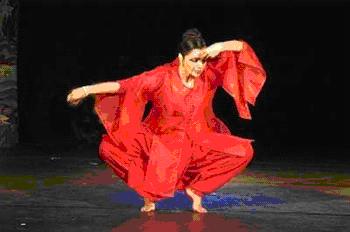
ON a stage bathed in red, garlands of severed heads rested heavily on the bloody chest of the goddess that appeared in the revered forms of Kali, Tara, Sodashi, Bhuvaneswari, Bhairavi, Chinnamasta, Dhumavati, Bagala, Maatangi and Kamala. Her devotees trembled in fear and were shocked at the paradoxical revelations of the divine.

“Hell hath no fury like a woman scorned” – this proverb, adapted from a line in the play The Mourning Bride, by William Congreve (an English author of the late 17th and early 18th centuries) certainly seemed accurate to describe the scene. Who would have thought that the usually sensual Odissi, one of the oldest Indian classical dance forms, could conjure up such emotions?

The choreographer for Arousing the Spirit Within – Revelations of Odissi was Guru Durga Charan Ranbir from India, a direct disciple of the late Guru Deba Prasad Das who was one of the four principal gurus who participated in the reconstruction of Odissi dance in the 1950s. He was the first to introduce this dance form to the world through the performance of his disciple Priyambada Mohanty in 1954.

Today, Durga Charan is regarded by critics and dancers alike as the successor of Deba Prasad’s dance legacy, which is distinguished by earthy poses, fiery energy and subtle but intricate gestures and emotions. Like his master, he believes that the performance should be all about keeping true to the dance vocabulary.


“I use the Odissi language to make my own choreography, which helps to further the Odissi tradition in its own way. And the key to keeping Odissi alive is to take it around the world to different audiences and students,” he said.

The recent show was presented by the Kalpana Dance Theatre, founded by Malaysia-based Bharatnatyam danseuse Shangita Namasivayam. The performance featured well-regarded danseuse Leena Mohanty and up-and-coming Odissi star Debashish Pattanayak from India, and Malaysians Daisygarani Vidhyakumari, Praveen Nair, Vidhya Pushpanathan and Anusha Nair

Deba Prasad’s dance legacy was displayed most convincingly in Sthai, which boasted an amazingly complex and tedious choreography. The dance piece revealed sculptured poses which were conveyed in a duet performed by Parveen Nair and guest artist, Debasish Pattnaik. The undulating torso and shoulder in seamless transition and motion – a natural effect of tribhangi (the body bent in three places forming an ‘S’ shape) – were tuned to the constancy of the mnemonic syllabic line which was sung hypnotically. Yet, their darting eyes, fluid wrists, twirling hands, and accented footwork reacted to the shrill melody from the flute lead.

The six-part dance also included Mangalacaran, Pallavi, Dhira Samire, and Moksha. Mangalacaran was an invocatory piece dedicated to Lord Shiva and the dancers demonstrated their devotion through prayerful gestures and by giving offerings. Pallavi was performed to the beautiful raag, Kedar Kamodi, an ancient classical Indian melody and the piece exuded a rather brisk Odissi style.

The stop-move-stop-move choreography challenged the fluidity normally associated with this dance form and the music was, on occasion, overbearing and distracting. The dancers could also have been more accurate and sharper in their movements to bring out the full essence of this brisk-style choreography.

Dhira Samire was an “abhinaya’’ or expression piece. There was intricate but subtle choreography for the facial muscles, eyes and fingers, making the dancers independent storytellers of the famous Geeta Govinda (Song of the Cowherd), a work composed in the 12th century by the great poet-composer Jeyadeva of Puri, Orissa.

In this story, Radha’s confidante urges her to meet Krishna who is waiting for her by the Yamuna River. The boost of confidence gave Radha the opportunity to develop a relationship with Krishna. In this scene, Leena Mohanty, Daisygarani Vijayakumaran and Parveen Nair each played their part well.

Moksha, the concluding piece, did not depict a sense of independence or the joy of liberation. It heavily echoed the earlier Dasa Mahavidhya section and could not find release from its brooding sentiment.

One setback of tis production was the lighting. Though dance was the focus, a little attention to design and texture in lighting would have greatly enhanced the overall impact of the performance.

(D) Hiding Love - Jan 14, 2007

Pix Source: The Star


LAST weekend, in the cosy Panggung Bandaraya theatre in Kuala Lumpur, a tale of love and pain unfolded – rather murkily.

The story was told through contemporary dance, a genre rife with great risks and rewards: if you get it right, it’s spectacular; if you get it wrong?.

Not that the Kwang Tung Dance Troupe got it wrong. Choreographed by Steve Goh, Hiding Love had wonderful, lyrical moments that were executed almost flawlessly. What was lacking during the hour-long performance, perhaps, was enough story-telling and dramatic expression to convey the different facets of that most complex of human emotions, love.

The dance was performed by Faith Toh, Samantha Chong, Louise Yow, Tin Tan, Chin Kah Voon and Goh himself.

It began as a mellow affair. Complex situations force people to hide their true feelings, thus the sombre overtone projected during the performance. To match, black and white prevailed in costumes and backdrop.

In the first of five sections, Goh danced mechanically with his partner, showing no love, nor any other emotion. Instead, he stole glances at another dancer who was stretching sluggishly under a spot light.

In the next section, a dancer emerged, her movements portraying happiness, yet still quirky and erratic – until, that is, Goh joins her. Suddenly, arms, legs and bodies work smoothly and the pair are synchronised.

But the happy moments are as fleeting as their flitting movements between the pillars. Too soon, she realizes that this happiness is not hers to take and she pushes him away. At the back of the stage, hands are extended from around the pillars, reaching, grasping, and finding only thin air: love is beyond reach.

A beautiful duet ensued describing the intense pain of one having to hide love. This was the most expressive section of the dance.

It entailed a lot of travelling, lifting and jumping. The notion of tension and release characterised the movements of this duet, and there were clear repetitions of sequences.

In the end, all the dancers emerged wearing white. Each had their turn performing solo. But each was surrounded by chaos.

There was a fury of movement as the dancers ran back and forth and to and from the pillars and in circles.

Movements were fast and furious, displaying a sense of agitation and unsettledness – of people having to hide deep emotion, I presume.

The busy group work calmed down and a dancer wearing a bright red dress performed a silent solo that concluded the performance with a final display of pain and agony.

Overall, Goh displayed a good grasp of the modern contemporary dance genre though there was a hint of modern ballet in some parts of the choreography that undermined the “contemporary” tag.

In the end, though, it’s not the purity of the genre or the complexity of the theme that makes for a standout performance. It’s how you tell your story, and Goh could have handled that better.

Saturday, March 31, 2007

(M) Alih PungGONG - March 11, 2007

Pix source: The Star

"A WOMAN is like a tea bag. You won’t know how strong she is until you put her in hot water.” That was my favourite line in Alih PungGong, a kick-butt performance presented by all-female gamelan group Rhythm in Bronze, Five Arts Centre and the Actors Studio at the Kuala Lumpur Performing Arts Centre last weekend.

Alih PungGong is a continuation of the spirit of exploration that first emerged in Rhythm in Bronze’s Monkey Business in 2005 under the direction of the great, late Datuk Krishen Jit. The concept was based on music woven together with short theatrical pieces and movement.

And this time, it was all about women and what great creatures they are! The image that remains etched in my mind is of the performers holding percussive hitting instruments in mid-air as if ready to beat the daylights out of someone. I'm fondly reminded of Dixie Chicks' Not Ready to Make Nice.

While some women might have preferred to be throwing oranges (these days, with their mobile numbers scribbled on them), I was happy to be amused by the Mandarin Rebellion on that rainy Chap Goh Mei afternoon (March 3) entertaining such thoughts as, “Did a male chauvinist write the Kamus Dewan Bahasa?” while a performer read an endless list of negative adjectives that go with the word perempuan, Malay for woman.

The theme on women came across loud and clear in the dramatic interludes thanks to Nam Ron and Loh Kok Man’s theatrical direction. The interludes were inspired from the element of “extra turns” in bangsawan (Malay opera) that emerged in the early 20th century.

In these extra turns, dancing girls, clowns, jugglers and acrobats took their turns to entertain the crowd as the stage crew made scene changes. These short interludes became so popular with audiences that they became larger and larger in scale through the years, sometimes almost overshadowing the main act, in fact.

Not that the main act of this show was overshadowed. This time around, Rhythm in Bronze featured eight new compositions under the musical direction of Jillion Ooi and Susan Sarah John (making her debut as music director).

Mohd Kamrulbahri Hussin on percussion and Isyam Swardy Daud on guitar joined the troupe as guest performers. They introduced a wider range of sounds that went well with Rhythm in Bronze’s contemporary style.

Suita Malayanaries carried a soft, sweet melody while Sekar Anyar, in contrast, was fast and furious, painting what they described as a “landscape of fire and bronze”. With the saron (bronze slabs) leading the melody and the bonang (bronze kettles) echoing it, the sound kept to a high pitch.

Ketawang (traditional Malay court) depicted the mood of a “funky Sunday afternoon” with all the instruments coming into play.

My favourite was The Wind, a soothing, dreamy piece, with music by Hardesh Singh and lyrics by Yasmin Ahmad (yes, the filmmaker – multi-talented woman, that!). The lyrics describe how a kite makes us see the wind. This nostalgic piece would make for great chill-out music.

Lorna Henderson, a violin fiddling musician from Britain rendered a solo and later, accompanied by the bronze ensemble, gave us In the Beginning, a piece depicting insect heartbeats. Adding to the sound was the visual: other musicians, when not playing, held their hitting instruments in the air, hovering like insects.

Race, a “symphony of crabs” focused on non-bronze instruments. The highlight of this piece was the gambang (wooden xylophone) and the troung, a Vietnamese bamboo xylophone.

In Lagu Untuk Teman Lama, the bronze ensemble combined with the percussion ensemble to come back with umph! Most interesting in this piece was how the gongs, soft and subtle, droned a melodic bass.

Runtuh was filled with accents and punctuations as hitting instruments fell heavy on the bronze. With its interchanging melodies and rhythms, this piece was intriguingly more complicated than the rest.

Last but not least, I must applaud artist Bayu Utomo Radjikin’s beautiful set and costumes. The umbrellas, hung in the air, created several imageries at once: treetops, shades, and the familiar pelita (oil lamp).

I have to say that, since Rhythm in Bronze’s first attempt with this style in 2005 in Monkey Business, the “monkey” has evolved.

Monday, December 25, 2006

(D) Sankai Juku

WHAT wonderful opportunity it was to catch Sankai Juku, one of the world’s foremost butoh dance companies, in its first appearance in Malaysia.

After performing in 40 countries, the company finally arrived on our shores to present its award-winning Hibiki: Resonance from Far Away last weekend at the Kuala Lumpur Performing Arts Centre.

From the first appearance of the dancers, I was held enraptured. They appeared on stage with their bodies painted completely in white, looking identical and surreally ageless. There did not seem to be any reflection of the passage of time on their faces.

According to Ushio Amagatsu, artistic director and founder of the 30-year-old dance company, the life of an individual is “non-continuous”, in the sense that there is a start and an end. But the life of mankind could be described as being continuous, like a flowing river because, as a species, mankind has been alive for centuries and will continue to live. The resonance created by this “non-continuity” and “continuity” is what inspired Hibiki.

Pix source: Japan Foundation, KL


The six-part dance comprised Sizuku (drop), Utsuri (displacement), Garan (empty space), Outer Limits of the Red, Reflection and Toyomi (resounding).

The first sounds heard in the theatre were “drops of life” – water dripping from suspended glass urns into water-filled concave glass lenses on the sand-covered stage. The set looked like an oasis in the desert; an apt metaphor for Sizuku (drop), which is about the source of life. The first hint of music stirred five figures that had been curled foetally in the spotlight, which was, presumably, the womb.

Three dancers remained on the darkened stage in Utsuri (displacement). This segment seemed purposeful and directed with its slow and steady synchronised movements. The dancers’ fingers and hands were always pointing forward; and as they moved forward, they engaged in a triangular love affair with gravity, courting tension, relaxation and resistance.

At some points, the dance seemed to depart from traditional butoh movements (which are slow and very stylised), especially when the dancers started to gyrate and twirl their hands above their heads like Hawaiian hula dancers. Unlike most butoh performances I’ve seen, in which movements are extremely tense, a sense of relaxation permeates Amagatsu’s work.

In the next segment, two dancers entered as asymmetrical dancing twins. They carried out simple, everyday actions – they waved their hands, pointed their index fingers upwards, beat their chests, tapped each other’s shoulders, and so forth. As this duo entered, the earlier trio exited. Action took place at two ends of the stage in this simple, elegant choreographic design.

In Garan (empty space), a solo dancer stood in one spot making slow, miniscule movements; his face serene and his eyes far away. He reached down to dip his finger in the “pool” of water and tasted it. And his reaction seemed to say, “So that’s what life tastes like!” This piece somehow emanated sensations of comfort and security. It put us at ease because, deep in our primal self, we recognised that resonance of life and we are always comfortable with what we know.

In Outer Limits of the Red, four ghastly figures in crescent formation hovered over a bloody concoction in a glass cauldron. Men in skirts, corsets and earrings muttered spells and flicked “blood” from their hands into the cauldron.

If dance has a horror “genre”, this scene would surely be representative, as it had all the elements of a good horror movie: fear, danger, suspense, shock, and even “bloodshed”. And, yes, it even had a climax, one that made every effort to startle and engage.

Reflection, on the other hand, was anticlimactic. I was at lost trying to understand what the solo performer was trying to convey. The lighting was interesting, though. An “X”-shaped path was “drawn” with orange light across the blue-lit stage and a red “pool” was distinctly marked out by a spotlight.

Toyomi (resounding) paid tribute to birth and the cycle of life. As the dark curtains behind the dancers were drawn away on either side, I felt like a baby witnessing my own birth from inside the womb and seeing light for the first time as my mother’s legs are drawn apart in preparation for my arrival.

And then, in a coda that surely demonstrated the cycle of life, the dance ended as it had begun, with the dancers in the foetal position.

To the thunderous applause of the audience, Amagatsu, in true prima donna fashion, gave us even his bow in butoh style. He can get away with it because, I have to concede, Hibiki was certainly one of the most beautiful butoh choreography I’ve seen.

Pix source: Japan Foundation, KL

Saturday, November 25, 2006

(D) Tapestry 2006 - Nov 19, 2006

THROW away those racial unity textbooks and pick up performing arts instead. It’s becoming obvious to me that that’s the better way to foster the much-talked-about muhibbah spirit: once you sing it, act it and dance it, you will inherently live it.

At Akademi Seni Budaya dan Warisan Kebangsaan (Aswara), each student is instilled with a thirst for knowledge, the urgency to preserve her cultural heritage, and a deep respect for diversity. It is one of those few places where everyone is genuinely interested in cultures other than their own.

With scant regard for race, religion and background, students from its dance and music departments got together to put up Tapestry 2006, a showcase of Malaysian folk repertoire, at the Experimental Theatre, Aswara campus, Kuala Lumpur, last weekend. The songs and dances were stitched into an evening celebrating Deepavali and Hari Raya.

Eleven dances were presented, many of which are rarely performed in KL. One such is the colourful dansa of the Malay Cocos, who live in Tawau and Eastern Sabah. If not for the hint of batik, one would have thought that this was a Western folk dance.

Performed by couples, it is similar to the European dances of Spain and Portugal in terms of music, costumes and movement, with Spanish melody, lively footwork and loud, frilly blouses worn by both the men and women. Dansa is believed to have been passed on to the local populace by sea-faring tradesmen and travellers.

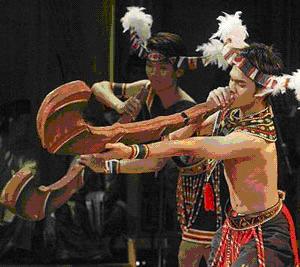
Another item featured was the rejang be’uh, a Bidayuh dance taken from the village of Semeba, near Kuching. This dance is known for its fast tempo and there was a playful quality between the male and female performers. Many of the movements are derived from daily activities, like imitating birds in flight, as well as footwork that focuses on weight transference.

Rejang Be'uh. Pix source: The Star

Adai-Adai was originally a Brunei folk song. It tells about life in the fishing villages, where the men leave early in the morning to earn their daily keep and the women folk await their return. Over the years, a new traditional dance has been created to accompany this folk song.

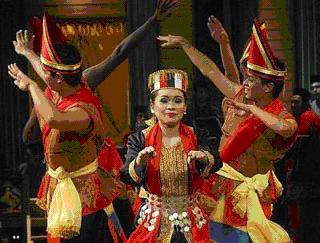
The highlight of the programme was the tari inai, a highly skilled folk form from Pasir Mas, Kelantan. It is a derivative of the mak yong and silat in movement, costume and music. The blare of the serunai (flute) and the delicate fingerwork are strong references to the mak yong tradition, while the swooping hand movements are culled from silat. Also unique in this item was how the dancers bent all the way back to pick up a piece.

Tari Inai. Px Source: The Star

Zapin Bunian, widely performed in Johor, takes its name from the area where it was developed – Kamping Sri Bunian in Pontian. The dance is thought to have been brought to Malaysia by Arab merchants in the 1500s and is synonymous with the spread of Islam. The unique movements of the torso, and the changing rhythms and dynamics of the dance and music make it one of the most exciting folk forms. Originally performed only by male dancers, zapin is now choreographed to accommodate male-female pairs, like in this piece.

Zapin Hanuman was inspired by the Ramayana. Infused with elements taken from the dances of the Middle East, this dance became popular in the 1970s through the work of choreographers such as Syed Hanasuddin and Yahya Abd Hamid. At Tapestry, this item was fast and vigorous – the dancers were practically running, and they performed many turns, hops, and little kicks. It was certainly a test of stamina for them.

The inang renek was choreographed by Wan Nor Mohammad Wan Alam and danced to the tune of Inang Tua. This must be the Malay version of Shakira’s Hips Don’t Lie. This cute and endearing piece saw the dancers take tiny little steps while shaking their hips regularly.

The production also featured two Indian and two Chinese dances.

Veteran classical Indian dancers Radha Shetty and Vatsala Sivadass guided the students in a stunning classical jatiswaram kalyani performance and a spear-bearing Assam dance. Jatiswaram is a pure dance section of the bharatanatyam repertoire, a classical Indian dance form, while Assam is a folk dance from the Indian state of Assam. The latter depicted village men hunting and women tending to their children and farming.


Assam Dance. Pix source: The Star.

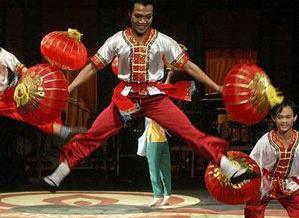
Aswara lecturer Wong Kit Yaw choreographed the Chinese lantern and fan dances. Both pieces manipulated hand-held props to full effect. Wong always makes his work visually appealing; it felt as though I was watching a piece of art take life.


Lantern Dance. Pix Source: The Star.

The performance concluded with joget, a folk dance form that is widely regarded as one of Malaysia’s national dances. It is similar to the branyo dance, which has Portuguese origins, due to its distinct time signature and the quick change of weight with the feet. Aris Kadir’s composition had a lively, cheeky quality and was performed by playful partners.

To sum up, Tapestry 2006 displayed the vibrancy of our cultural heritage and a celebration of unity in diversity.

(D) Interview with Ushio Amagatsu - Nov 22, 2006

Photo by Bridgit


The world-renowned Sankai Juku dance company, which specialises in the highly stylised Japanese dance form known as butoh, will make its first appearance in Malaysia with the award-winning dance, Hibiki: Resonance from Far Away. Break-a-Leg has an e-mail interview with Ushio Amagatsu, artistic director and founder of the 30-year-old company.

AMAGATSU-SAN, you have, reportedly, created your own version of butoh. What is it like?

I would say, “to each his own style”. What those of my generation went through, the experiences that I’ve had as well as my qualities as an individual are different from those of the first generation of butoh dancers such as Tatsumi Hijikata and Kazuo Ohno.

You were trained in Western classical as well as modern dance. Why did you choose to focus on butoh?

The 1960s and 70s in Japan was a time in which doubts and questions were being raised about the arts. Through my encounters with numerous people during this period, I was introduced to our own dance style, butoh. I did not make the decision to immediately enter the world of butoh after watching its performances. But, eventually, the attitude toward creativity and the methods utilised by the first generation of butoh dancers made a tremendous impact on me.

I find it interesting that you have reportedly described dance as ‘a dialogue with gravity’. How does this relate to your dance philosophy?

The word “dance” is a synonym for tension, and human movement is composed of two states: “tension” and “relaxation”.

A newborn baby spends about one year on its back before he stands and begins to walk. Once he learns to stand on one leg he can produce steps and rhythm to form a dance; or, in other words, being able to stand on one leg is the beginning of dance. But my approach to dance looks at the body before it learns to stand, as well as the process it goes through to get there. This is the dialogue that the horizontal body has with gravity until it learns to stand. It is the attempt to master tension from a base of relaxation.

Western dance would generally relate to the concept of liberation or rebellion from gravity while the basis of my work would be a synchronisation with gravity.

In 1980, you were invited to perform in Europe for the first time. How do Europeans relate to butoh?

I believe that the way butoh utilises the human body is not the same as the way Western dance forms utilise the body. Butoh’s different method of expression has been accepted as a distinct approach towards contemporary dance. Those who have been influenced by it have gone on to create yet other styles and forms.

You have performed in more than 700 cities. Are there similarities and differences in how butoh is received around the world?

Similarities would be in the primitive emotions expressed so well by butoh; primitive emotions that all humans possess, and the impression that they get from seeing these emotions within butoh. But there are some minor differences in their (the audience’s) reaction depending on race and geographical region.

What is the inspiration behind Hibiki?

The life of an individual is “non-continuous” in the sense that there is a start and an end. But the life of mankind could be described as being “continuous”, like a flowing river, in the sense that it has been around and will continue to be. The resonance of life in relation to this “non-continuity” and “continuity” is my source of inspiration.

How is Hibiki different from your other works?


I do not think there is any major difference from the other works. There have been 15 Sankai Juku works so far but I’ve not thought of doing something that is totally different from my previous works for the sake of variety. My works are a culmination and snapshots of the creative process that had taken place up till that moment.

You have done well in your career. Do you think that you have accomplished your personal goals?

For me, unresolved issues are the impetus for creation, and so, there probably is no final goal. And although I make the effort to search for answers, it is probably because no clear answer can be found that I can continue to create.

(D) Seven Graces - Nov 3, 2006


CAN you imagine a group of senior citizens dancing on stage and attempting more movements than their osteoporosis-ridden bones allow? It’s a thought that makes one cringe.

Sadly, our socially-conditioned image of dancers – perfect physique, graceful and agile movements – leaves very little room for us to think otherwise. Generally, mature dancers performing tap, folk and social dances can get away from scathing comments. But not so for those who take up ballet, hip hop, breakdance and contemporary dance.

“I am most interested in exploring the richness and the possibilities of a mature woman – I’m 50 this year – expressing herself without pretending to be younger than she is,” said Anita Ratnam, who is bent on challenging conventional mindsets.

Ratnam was in Kuala Lumpur last weekend to perform Seven Graces, as part of the third (and final) flush of the “Under the Stars Series” 2006. The show, which rounded up Sutra Dance Theatre’s performance season for the year, is her solo “operatic” creation. She worked in collaboration with Hari Krishnan, an India-born, Canada-based dancer, choreographer, teacher and dance scholar.

In India today, Ratnam notes, solo work does not figure in contemporary dance, which usually features group choreography. Thus her solo dance challenges yet another “norm”.

Chennai-based Ratnam wears many hats. She is dancer, choreographer, transcultural collaborator, arts presenter, scholar, writer and cultural activist. With a career spanning four decades and having staged over 1,000 performances in 15 countries, it’s not surprising that she is one of India’s most recognised dance icons.

Apart from being trained in bharatanatyam and the Kerala dance traditions of kathakali and mohiniattam, she holds a Masters degree in theatre and television. She returned home to Chennai, after a highly successful 10-year tenure as TV producer and commentator.

Seven Graces highlights Ratnam’s perspectives on goddess worship, and the many facets of Buddhist goddess Tara, and feminism.

Tara is one of the most ancient of goddesses still worshipped extensively in modern times. Legend has it that White Tara rose from a lotus blooming in the lake that formed from the first tear of compassion of the great Bodhisattva Avalokiteswara – tears that fell when he first beheld the scope of suffering in the world.


In other parts of the world, Tara is known as Tar (Finland), Kuan Yin (China), Terra (South America), IshTar (Egypt), Isis (Italy) and Agni Tara (Northern and Central Asia).

But this piece is not a literal re-telling of Tara’s attributes. Instead, Ratnam used the mythology of the goddess as a thematic reference point and each facet of Tara’s life reflected the choreographer’s personal journey as an urban Indian female.

Seven Graces had seven sections, each represented by a different hue – black, yellow, blue, red, green, white and saffron. Black represented birth and the darkness of the womb; yellow, childhood; blue, a youth negotiating her inner space, and discovering herself; red, a woman’s fierce passion and compassion; green, her wisdom and intelligence; white (where all colours merge into one), motherhood; and saffron (the most holy of colours), the woman’s embodiment of Buddha and her renunciation all things worldly.

Ratnam created a whole lexicon of gestures for the piece. Her gestures were not the conventional mudras used in classical Indian dance, but gestures developed from statements that represented significant areas of her life – such as “my children” and “mother holding on to the umbilical cord” – and from statements on the goddess Tara, such as “centre of the universe,” and “there is no one like her”.

The soundscape was particularly interesting. The blend of music from western and eastern (Tibetan) instruments, voice and sound effects culminated in a composition that enhanced and complemented all seven sections of the dance.

The music made Ratnam seem as if she was moving faster than she actually was, allowing her to move in ways natural for her age. Anita did not try to be younger than she was and she managed to maintain her dignity as a mature female dancer.

In this contemporary piece, the distinctive Indian flavour was not so much a derivative of classical Indian dance but more, a derivative of Ratnam, the archetype of today’s urban Indian female – intelligent, vocal and successful, yet grounded in tradition.

(D) Interview with Anita Ratnam - Oct 29, 2006

Anita Ratnam. Pix source: Sutra Dance Theatre

She’s lived a rich life, and now she wants to share it through almost one hour of non-stop dance. Break-a-Leg speaks to the great Indian dancer and feminist, Anita Ratnam.
ANITA Ratnam wears many titles: dancer, choreographer, transcultural collaborator, arts presenter, scholar, writer and cultural activist.

Add to all that the fact that her four decade-long career encompasses more than 1,000 performances in 15 countries and it’s not surprising that she is one of India’s most recognised dance icons. Apart from being trained in bharatanatyam and the Kerala dance traditions of kathakali and mohiniattam, Anita also holds a Masters degree in theatre and television.

She returned to her home base in Chennai, India, from New York after a highly successful, decade-long tenure as TV producer and commentator.

Malaysia will see this connoisseur’s dancer on stage when she presents Seven Graces early next month at Amphi-sutra, Kuala Lumpur.

Seven Graces is Anita’s solo “operatic” (see her explanation of this intriguing concept below) creation in collaboration with Hari Krishnan, an India-born, Canada-based dancer, choreographer, teacher and dance scholar.

The piece features Anita’s perspectives on goddess worship, the many hues of Buddhist goddess Tara, and feminism.

In an e-mail interview, Anita shares her thoughts about Seven Graces and about a subject close to her heart: feminism.

Why did you choose goddess Tara as your reference? /strong>

Goddess Tara chose me! My good friend, Arvind Iyer, a writer in Bombay and a Buddhist, saw me as the goddess in his dream. In his dream, he saw the colours, the moods and the images and sketched the first mood-mosaic of the goddess Tara for me.

The goddess is so full of life, humour, passion and compassion – like a mother. I loved that, being a mother (of two teenaged girls) myself. These elements lent themselves perfectly to choreography.

What are the seven graces?

Seven is the “number of the Universe” – there are the seven ages of men, seven cosmic stages, seven charkas of human consciousness, seven pillars of wisdom, seven sacred rivers, and so forth.

The number represents completeness, totality, perfection, plentiful-ness, rest, reintegration, safety, and synthesis.

In this work, I speak of the many stages and moods of a woman and a goddess – from the pain and darkness of birth, to the wonder of a young girl discovering her space, to a woman and a mother kindling the inner and outer worlds, the healer and shaman at work, an ascetic in ecstasy and, finally, the invisible space and colour for reunification and renunciation.

Seven Graces is a colourscape, a moodscape, a dancescape, and a lifescape. It is my life danced in one hour. It is the images and moods of the mythology of the goddess Tara collapsed into the personal mythology of who I am today.

Can you explain how these feminist and goddess worshiping themes came about?

I led the most unconventional life between the ages of 21 and 35 – I left my hometown and country for New York and lived there for 13 years – and I was married twice. The first marriage was arranged by matching horoscopes, and then, later, I fell in love with an older man. All these experiences transformed my views of feminism and contemporary mythology.

Reclaiming the “sacred feminine” is a very large part of my worldscape and my dance motifs. The goddess (not just the goddess Tara but the feminine aspect of all goddesses) does not only dwell in temples and churches. She is everywhere today – in nature, in music, in our bodies, in art, in architecture, and in every breath we take.

So worshipping the goddess (in the form of the goddess Tara), to me, is not merely through prayer or ritual but through a life lived with passion, honesty and curiosity.

What do you mean by “operatic creation” in the context of dance?

The word “opera” has a larger-than-life connotation. When it comes to Seven Graces, well, for one thing, it is not often in solo contemporary dance work that a performer occupies the stage without a break for almost one hour – that’s quite “large”!

Also, music, sounds and emotions are plundered and go beyond the merely beautiful and appropriate.

All this has the sense of not just dance or drama, but also of opera. Through the dance I really am, in the words of writer Pico Iyer (one of the world’s best-known travel writers), “a continent of one”.

How is Seven Graces a departure from conventional contemporary Indian dance?

I use props almost always in my work. Not having any was new for me. Not having any text to work with, no script, no cohesive music score ... these are all very new in an Indian contemporary dance context.

Most contemporary dance in India does not deal with solo work. Group choreography usually signifies contemporary work in India today. The classical dance format, on the other hand, is primarily a solo form. In life I am a loner and it seemed most honest to continue this thread in my work Another thing that is different about Seven Graces is that I am most interested in exploring the richness and the possibilities of a mature woman (Anita is 50 this year) expressing herself without pretending to be younger than she is – and this, too, is rare in Indian contemporary dance today.

Where does feminism stand in India?

India is virtually throbbing with many versions of feminism and I am truly proud of being a woman in this country today.

Women in villages, cities and slums are simultaneously claiming their place in society, whether at home or in boardrooms. One of the world’s most powerful CEOs is an Indian woman from my hometown – Indira Nooyi of PepsiCo (she took over the American food and beverage company on Oct 1).

Feminism in India today is about embracing our “female-ness”. “She” is not self-conscious nor does she negate any aspect of herself. I am a feminist and a “womanist”. I have chosen to live alone as a single mother of two teenagers for the past 16 years and that has defined me more than any other experience.

Where do you think feminism stands within Asia?

I feel that Asian women are particularly challenged when it comes to freedom. Not just in India, but in Malaysia, Korea, China, Japan, the Philippines and Thailand.

Women have more options today, yet they are more objectified than ever in music videos, movies and mindless television serials. We are being made weaker and dumber, and our bodies are encoded with layers of patriarchal condescension.

Mythology and history can teach us of the potential that lies within each woman. After all, (Indian goddess) Kali, (Egyptian goddess) Isis, (Greek goddess) Athena, (ancient Sumerian goddess) Inanna and (Chinese goddess) Kuan Yin are only reminders of the qualities that are dormant within all women.

What were Hari Krishnan’s contributions to this collaboration?

Hari served as co-choreographer and director of Seven Graces. He helped me with research as well as on the extended improvisational sections of the work.

Being much younger than I am, Hari brings a fresh dimension to the piece and challenges me constantly to remember my strengths as a woman and a dancer.

He insisted that I create phrases from personal sentences I had written in my research for this piece so that my own personality as an urban Indian woman could also surface and co-exist in the work.

Hari, too, thinks that Seven Graces represents a departure from conventional contemporary Indian dance in many ways. For example, we deliberately chose not to work with any text or slokas (Sanskrit verse).
Also, I want to perform the work without props, since I feel the rich movement vocabulary, emotional intensity and eclectic soundscape will be sufficient for the work to speak to a range of audiences.


Hari Krishnan. Pix source: Sutra Dance Theatre


Why did you choose to dedicate your life to dance?

I don’t think that one can choose dance. Dance chooses you. In my case, I ran from dance at age 21. But I was pulled right back into it at age 33. Dance is not a job or a profession. It really is a calling. Also, while I am known best as a dancer, I feel that I have so much more to communicate to the world. For now it seems to be that dance is the way for me to engage with the world.

Tuesday, September 26, 2006

(D) Kuilenga - Sept 9, 2006

The spirit of West Africa took Akademi Seni Budaya Dan Warisan Kebangsaan (or ASWARA, formerly known as Akademi Seni Kebangsaan) by storm last weekend as students, graduates and teachers gathered at the school’s Black Box Theatre to witness Kuilenga, meaning The Door, in the Burkinabe language, Moaga. Best of all, the performance was free since the academy wants to expose local audience to diverse and lesser-known dance genres in Malaysia.

Kuilenga is a full-length production by the Baker & Tarpaga Dance Project (BT Dance Project), a contemporary dance company directed by Esther Baker-Tarpaga and Olivier Tarpaga. The husband and wife team founded the intercultural company in 2004 and they are based in Los Angeles, California and Ouagadougou, Burkina Faso.

Olivier Tarpaga and Esther Baker-Tarpaga

But due to stage limitations at the experimental theatre, the couple presented only one segment of the full-length that addresses themes of love, immigration, displacement, and the physical boundaries between violence and peace.

Kuilenga, according to Esther and Olivier, is a reflection of their lives as they travel from place to place. While the dance is about how they move across time and space, it is also about the lives and movements of other people. This contemporary dance also drew movement vocabulary from West African traditional dances such Gourmantche (a dance from an ethnic group in Burkina Faso) and Sabar (danced to Sabar drums from Senegal).

The dance began with two still figures on stage. One remained still, while the other started twitching his upper body, exploring limb after limb before working himself up into a convulsion (movements from Gourmantche). The sudden explosion of drums after a period of silence signalled the first signs of body contact where the couple took turns to roll over each other’s back.

The dancers used the energies of “push” and “resistance” in actions that seemed like wild animals butting heads and people fighting each other. The message was that fights are futile and doesn’t get anyone anywhere, since spatially the dancers did not move.

Fighting done, they moved away from each other in gliding and sweeping movements across the floor. After moving one full circle, the dancers came together and locked themselves in embrace. It was only after this “kiss-and-make-up” scene that we saw the dancers share similar movements - sometimes in unison and sometimes one after the other.

Then, in full display of their individuality and identity, they each broke into a variety of West African dances bringing exciting, dynamic, and rhythmic energy to the stage. When the “this-is-me” statement was done, they walked off stage hand-in-hand with their back towards us, in a sweet, happy ending.

The couple were also in ASWARA to give a weeklong workshop, which the participants, comprised of drummers and dancers, at the end of it, showcased what they’ve learnt - Diansa (celebration dance) and Mandiani (fast dance for young girls). ASWARA students and graduates make up most of the dance participants while the drummers comprised of ASWARA students, guest performers Tony Tang (percussion teacher from Sri Cempaka) and teen Andrew Kam (child prodigy listed in the Malaysia Book of Records for passing his Grade 8 percussion exams at the age of nine).

It was a carnival when the students burst forth on stage singing, clapping, and dancing to the rhythms of the live drum ensemble led by Olivier on the djembe (a drum from Burkina Faso). It made me think what a great youth program this would make when I observed how much the kids were enjoying themselves. All those excess energy that the youths have were poured out on stage. The dance combinations were simple and easy to learn; but that makes the dance accessible to everyone, even those who are not trained in dance.

“I never expected the students to be so good at it,” said Olivier, “because this is a culture totally different from theirs. But they just went all out and enjoyed themselves! Judging from the response of this workshop, we will definitely make plans for more.”

***

Contemporary Dance in West Africa

According to Olivier, the contemporary dance movement in Africa began in the '80s and the leading proponents of this genre are his teachers, Salia Sanou and Seydou Boro.

“At first, the people in Africa did not understand contemporary dance because it suggests a different way of expression. In our tradition, we burst forth with energy and go all out to express ourselves. But in contemporary dance, we play with different levels of energy. The people were afraid that it would hurt their tradition.”

“But now, people realize that contemporary dance does not hurt our tradition, but in fact, complements it. The contemporary dance scene is blooming in Burkina Faso. Every two years, we hold the Choreographic Encounter of Africa and Indian Ocean where 11 pre-selected dance companies compete against each other. The winner will get financial support and will be toured worldwide. Other developments include the building of the first Centre for Choreographic Development in Burkina Faso.”

(D) Sharira - My Body My Temple - Sept 8, 2006


I COULD not take my eyes off her face. No, this is not an introduction to a love story, but rather, a confession of what struck me most in Sharira – My Body My Temple, a solo bharatanatyam performance by Daisyga Rani from Kalpana Dance Theatre. She presented it as part of the Under the Stars Series 2006: Second Flush by Sutra Dance Theatre last weekend at Amphi-Sutra, Kuala Lumpur.

There are many ways a dancer can manipulate the movement vocabulary in bharatanatyam, but the expression (abhinaya) she projects makes a marked difference in the quality of delivery. The presentation by Daisy (as she is fondly known) is one such example, and it was refreshing to see her emphasis.

Daisy performed her arengetram (graduation) in February 1999 and has since been actively performing and teaching bharatanatyam in Malaysia.

Watching her perform was like watching a silent movie, except that it was live and in colour! From Puspanjali (an offering of flowers) to Ananda Narthana Ganapathy (a devotional item for Lord Ganesha), Daisy delighted by “talking” to the audience with an animated expression. She had so much energy and so much spirit in her.

In the Varnam, a piece that emphasises the need to be united with Shiva, Daisy displayed her technical mastery. She was not rushed in her execution and had a good sense of timing. What was attractive about this piece was the amount of attention paid to details, such as the description (through dance) of a leaf falling to the ground and a seed thrown upwards, which then blossomed in mid-air, among others.

Keerthanam – Chinna Chinna Padan (Little Krishna) was an interesting depiction of Krishna. It was the first time I’d seen Krishna depicted as a child. The opening of this piece had several children dressed as “little Krishna”, each in a different mode of play. The scene ended, to everyone’s delight, with one of them drinking buttermilk from a pot – a familiar scene from stories of Krishna’s childhood.

While the children had no problem playing little Krishna, portraying a kid was no child’s play. Daisy was only able to hold the role convincingly in parts.

In Padam – Netrandi Nerathila, Daisy played a heroine who sees her lover, Lord Muruga, flirt with another woman by a riverbank. In the dance, she confronts her lover and describes her pain. Wonderful as she is as an actress, the dance repertoire was overwhelmed by too much storytelling.

Finally, when the Thillana, a pure dance item, came on, I sat back and simply enjoyed the physical beauty of a trained body in movement.

In this production, Shangita Namasibayam, Daisy’s bharatanatyam teacher for 15 years and also artistic director of Kalpana, worked with Lam Ghooi Keat from the Temple of Fine Arts on the narration. They did a good job of carefully choosing words that best explained the meaning of each item in the repertoire.

(M)(D) Crossing Borders - Sept 20, 2006

CROSSING Borders, part of the Under the Stars Series 2006: Second Flush by Sutra Dance Theatre aimed to challenge definitions as we know them: like, what is traditional and what is modern? What is indigenous and what is foreign?

Performances were held last weekend at Amphi-Sutra in Kuala Lumpur. The evening began with Christopher Yohmei rendering Ichijo (The Immutable, composed by Seiho Kineya in 1975) on a shakuhachi (Japanese bamboo flute). Yohmei looked like a saxophone player, from the way he held the vertical instrument to the way he carried himself. But what he played was no typical jazz piece. The tune he rendered was distinctly Japanese. For several minutes, I enjoyed the haunting, gentle and mellow music. But after a while, boredom set in.

Traditional Japanese music played on the shakuhachi, just like the Chinese bamboo flute, can be manipulated to reflect the many sounds of nature – trickling rain, rustling leaves, birds chirping, the sound of horses galloping on a wide plain, and so forth. No doubt nature is a wonder in itself, but listening to this piece, I felt as if I was watching a plant grow.

Unfortunately, his next piece, Hienso (The Transitory) was no different. The “I-can-grow-old-listening-to-this” was reflected in the dance interpreted and performed by Ramli Ibrahim and Guna. They tried to show the concept of amica (impermanence) – meaning all things would eventually fade and die.

Ramli appeared as half-elf, half-shaman, flitting on stage with a stem. It was difficult to identify him as a delicate, blossoming flower – the image he was trying to portray. Ironically, the younger Guna appeared as the (artificially-greyed) old man bent with burden as Ramli left the staged. The interpretation of Hienso was all too literal.

I was stricken by Starstruck, choreographed by Rathimalar Govindarajoo. She attempted to cross borders by incorporating the kinetic energy of Bharatanatyam and martial arts, while informed by contemporary twists and sensibilities. However, “crossing borders” requires more refined and subtle treatment. I shifted uncomfortably in my chair as I watched the choreographer force different forms of art and ideas into her work, in invasive and intrusive ways.

A party comprising S. Felix (on the sitar), Jaya Sekhar (veena), Ravin Sikander (tabla) and Theban Arumugam (mirdangam and ganjira) provided musical relief with jughalbandhi, a blend of northern and southern Indian music which evolved 50 years ago.

They “crossed borders” by sharing one tune, rag keeravani (a melodic mode in Southern Indian music), and one type of rhythm – a 16-beat cycle (called peen paal in the north and eka paal, the south). It was sheer pleasure listening to Felix and Sekhar (the main artists) improvise on their respective instruments. Accents at different places gave delightful bursts of detail when one least expected it. The performance had my feet tapping throughout.

Next, a qawalli (devotional music of the sufis, performed throughout India and Pakistan) entitled Yadaan Bichde (Memories), which focuses on the theme of love was presented. Principal vocalist Haider Ali (who studied music under the Qawal family of the late Ustad Selamat Ali Khan), supported by vocalists Shah Rukh and Shabeer Ahmed, sung about how memories of a lover could pierce the heart. They then begged God to banish this pain of separation.

The style of singing was close to theatrical. The vocalists seemed to be having a conversation with each other and their animated expressions certainly looked it! At some point, I thought the singing was too loud and piercing, but I was told it was supposed to be that way.

Finally, all the musicians came together to present an improvisation on the rag gunkali, a melodic mode in Northern Indian music. In the improvisation, the Japanese shakuhuchi combined with qawali vocals and Indian instruments (veena, sitar, table and mirdangam) to create a cross-cultural and cross-musical experience.

The Hindustani rag shares almost the same melodic mode as the traditional Japanese miyako bushi scale (one of the scales used in Japanese art music). In this piece, the shakuhachi took the place of the bansuri (side-blown Indian flute) while maintaining its tonal characteristics.

Together, the musicians returned to the thematic melody to punctuate the improvisations while keeping to their own styles. They also collaborated with Sutra to present the highlight of the evening, a sneak preview of Navarasa (nine rasa) conceptualised by Ramli and Guna.


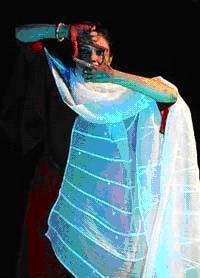
Navarasa (pix source - The Star)

The pair, together with seven other dancers, emerged masked. Their “frozen” faces were a direct contradiction of what the piece intended to portray – the nine human sentiments, that is, love, valour, compassion, wonderment, mirth/laughter, terror, disgust, anger and serenity. Even after the masks were removed, the faces were slow to melt into the sentiments. But, to be fair, the snippet we saw of the full-length Navarasa was too short to draw out the full potential of the choreography.

Friday, August 25, 2006

(D) Dream'n Butterfly - Aug 20, 2006

Pix source: The Star

JACK Kek Siou Kee performed Dream’n Butterfly, his first solo, to a packed Experimental Theatre at the Kuala Lumpur Performing Arts Centre last weekend. He also did the choreography.

The 29-year-old Trengganu-born lad (who was raised in Kuala Lumpur) was introduced to dance at 19 – he watched Lady White Snake by Mew Chang Tsing, principle of RiverGrass Dance Theatre. The performance spurred him to take up theatre and body movement classes with Woon Fook Sen, a theatre supporter and activist, and subsequently, contemporary and folk dance with Mew.

In 2002, Kek was offered a scholarship to pursue dance studies at the Hong Kong Academy of Performing Arts, where he majored in Chinese dance and took tap and contemporary dance as electives.

“I majored in Chinese dance because as a Malaysian-born Chinese, I want to discover my roots. Hong Kong is the best place for multi-cultural exposure. I learnt a broad scope of Chinese dance encompassing folk, classical and even acrobatics. If I were to study in Beijing, I would have to specialise in one pure Chinese dance style because the schools there follow a very systematic syllabus,” said Kek, who graduated in July this year with a Bachelor of Fine Arts (Honours) in Dance.

Dream’n Butterfly is a full-length contemporary Chinese dance based on a poem by Zhuang Zhi (369-286BCE), who describes how he dreamt of a butterfly, but woke up wondering if the creature had also dreamt of him.

“When I stand on stage as a performer, I make people believe that I am someone else. Offstage, I’m another person. Who am I? Through this dance, I want to make people wonder the same thing. “I chose this poem because Chinese poets rarely reveal how romantic they are. Most of them write about philosophy. If they do say anything romantic, they would not be so direct “Also, in Chinese culture, the butterfly is symbolic of something significant in life. For me, it’s a dream fulfilled – going to Hong Kong to pursue dance. The lifespan of a butterfly can be as brief as two days; as such, life is very precious and very fragile. I sacrificed all my money and time not knowing what the returns would be. But I really want to do this and I am savouring every moment of my dance pursuit,” Kek added.

Dream’n Butterfly reflects the “it’s-my-last-day-on-earth” attitude that drives him towards excellence.

In the first part of the dance, he portrayed a “man” surrounded by butterflies, as well as a “butterfly”. He toyed with illusion, the way magicians David Blaine and David Copperfield do: without leaving stage, he made both “man” and “butterfly” appear and disappear by interchanging his roles seamlessly.

He fashioned his own butterfly (usually represented by the middle finger touching the thumb with palm facing downwards) using hand gestures. He explored Chao Xian (a type of Korean dance) to depict the starting point of a butterfly’s graceful flutter. He used its breathing techniques to coordinate his body movements as he attempted to follow the erratic flight of the butterfly.

Kek tapped the water (or long) sleeve dance, Han folk dance and Chinese martial arts as the basis for his movement vocabulary. We watched his slow transformation into a butterfly as he first donned a costume with one long sleeve, then a bolero with two long sleeves.

The segment in which he wore one long sleeve was infused with a sense of torment, as if he was lost and unsure about his identity. He wet his sleeves in a makeshift gully filled with water that dripped continuously from the ceiling. He twirled the sleeve to form a “rod”, which he then used to hit several rows of metal rods hanging on the left of the stage, causing them to clash noisily.

The moments of torment passed and he ended with a multimedia segment filled with peaceful images – quite a contrast to the earlier scene. The dancer had found peace with his new identity – a white butterfly.

He assumed this new identity with confidence. With two long sleeves at his disposal, he showed his mastery in the water sleeve style. Like a reptile catching its prey with its tongue, he unfurled his sleeves, then retracted them with lighting speed. He displayed control by using them to form ripples, creating images of water flowing down a stream.

Pix source: The Star

Showing a touch of improvisation, Kek turned his sleeves into square handkerchiefs, the prop used in Han folkdance. Interestingly, he performed to tribal-sounding drums in this routine, giving the piece an uplifting feel.

In the final scene, a backdrop unfolded across the stage from left to right, revealing three layers of white vertical panels. He shed his wings and fled behind the panels, which were strongly lit with white lights.

Occasionally, his hands created a butterfly that appeared inbetween the panels, or as a shadow behind them. And then Kek, as man or butterfly, left the darkened stage. The butterfly was gone.

Dream’n Butterfly evoked a feeling of the surreal. What’s real is that Kek has proven his mettle in contemporary Chinese dance.

Friday, August 11, 2006

(R) Happy Birthday to good old me - August 11, 2006

Dear God,
I thank you for this day that you've given me,
for giving me life and for moulding me into who I am.
I thank you for your blessings, especially my loved ones.
And my dog :)
Amen.