
Thursday, October 18, 2007
Wednesday, August 22, 2007
(D) PINK - August 15, 2007
 Pix source: The Star
 The last time I watched Lena Ang perform was about a decade ago. In one piece, she chased a chicken around the stage; in another, she casually swallowed some sort of vegetation for a good 10 minutes, with a blank expression on her face. That was my first exposure to the shocking world of butoh – a post World War II Japanese dance form. Ang had introduced a new dance genre to Malaysia via fowl and fauna.
After a 10-year hiatus, Ang, dubbed the “Queen of Butoh”, is back in Kuala Lumpur for a “reunion” performance with scattered members of the Taro Dance Theatre (which she founded). They are Ang herself (based in New York), Ana Barbour (Oxford, Britain), Janette Hoe (Melbourne), and globe-trotting Palani Narayanan.
Ang’s choreography, titled Pink, was performed over three days last week at The Annexe, Central Market. The five-part performance was staged in different sections of The Annexe, thus the audience had to move around Galleries 1, 2 and 3.
Pink is what I would call “street butoh”, which cleverly infuses jazz and hip upbeat music that appeals to the (wo)man on the street. It moved away from being an art for the artsy, to being an art for every (wo)man. In fact, its theme, “the sweet and sticky side of gender stereotypes”, wasn’t too hard to swallow.
The dancers’ movements were not grotesque at all. They opted instead for a combination of slow and slightly contorted movements with intermittent twitches and spasms. On many occasions, they even portrayed, through plain and direct actions, the vanities of (wo)men.
Life in Plastic is Fantastic, which kicked off the show, saw the dancers lying in a circle with legs up. As they slowly reached towards the ceiling with their legs, a Barbie doll in pink cheongsam was passed from foot to foot. The legs thrust in mid-air ooked like a flower laden with “active” pollen. That, together with Barbie, combined to give the image of a fertile female.
In the Pink saw Ang, Barbour and Narayanan donning pink gowns, coats and top hats, in their element. They made a pseudo red carpet entrance, each hugging a half-bodied, naked mannequin of the opposite sex. Everything about their movements and facial expressions screamed look-at-me-I’m-a-star as they basked in their narcissism. The physical connection they made with the mannequin – touching, feeling, hugging – implied sexual discovery.
Moving to Gallery 2 from 1 for Let’s Eat Carrots Together, we saw a two-tiered stage – one above the wooden ceiling beams, and one at floor level.
The world below was that of a little girl (Hoe). Veiled in pink curtains, shrouded in pink fluff, and lit by dangling multi-coloured light bulbs, the sickeningly sweet scene questioned if femininity was inborn or a conditioned trait.
The scene on the upper stage with Ang stuffing tissue into her bra and Narayanan lifting weights, showed, above all, that beauty and vanity are common across gender.
There was hardly any pink left in Dog-Eat-Dog save for Ang’s underwear and Narayanan’s tie. Ang emerged as a human Barbie in a short, white cheongsam. As the title suggested, it was all about power struggles, dominance, ambition and control regardless of gender.
The crisp mechanical movements in Let’s Eat Carrots Together and the numerous lifts in Dog-Eat-Dog were a departure from traditional butoh, perhaps in the manner they were executed. Whether or not they were improvised, they didn’t flow smoothly.
In Gallery 3, Pinked-Out obliterated any trace of pink with the whole set in white. Dressed in white, each dancer held a mannequin’s arm or leg. Their mouths wide open in visible anguish, they showed that wiping out gender stereotypes isn’t so easy. It could “cost an arm and a leg”.
When the dancers dropped to the floor and lay still, the lack of activity shifted our focus to the gentle stir of the suspended mannequins that made up the stage decor.
Ang and Barbour had their own butoh styles; Hoe’s approach was more contemporary rather than butoh, while Narayanan needed a bit more concentration and focus.
Overall, Pink was a whacky, humorous and straightforward presentation of stereotyped ideas. It didn’t try to weave in any heavy social messages. In short, it was “butoh lite” that anyone could enjoy. With this first performance in 10 years, Taro Dance Theatre showed that it had lost none of its lustre.
Break-a-Leg is a non-performing former student of Lena Ang. She has never performed after she graduated.
Friday, August 03, 2007
(D) TARI '07 - August 2, 2007
 Khaol by Amrita Performing Arts (Cambodia)
Tari is the largest international dance festival that is sponsored by the Culture, Arts and Heritage Ministry through the Dance Department of Akademi Seni Budaya dan Warisan Kebangsaan (Aswara).
With generous support from the government, Malaysia made its mark on the dance map as all the top institutions from the Asia Pacific region turned up in full force to attend what is now one of the most sought after dance festivals in the region amongst educational institutions.
A total of 15 institutions were selected to participate in Tari ’07, which was held at Aswara, in Kuala Lumpur.
The biannual dance festival began in 1994 to launch Akademi Seni Kebangsaan (ASK) as it was then known and the festival now coincides with the development and expansion plans of Aswara, which includes launching new fields of study at undergraduate and post-graduate levels.
This year’s theme, Independence and Identity, gels with the nation’s celebration of its 50th year of independence. As the nation enjoys growth and stability, the focus turns to understanding and preserving our culture and identity.
One of the key components of the festival is its seminars where many papers presented on Dance in Tertiary Education. Compared to Tari 2005, presenters provided even more solid contributions. These will be compiled into a monograph that will record the teaching methods and challenges faced by these institutions and scholarship in the respective countries.
The dialogue and exchange of knowledge that took place strove to further improve standards of teaching, research and performance. The standard of arts education in Malaysia needs to be on par with that of other international institutions. It is heartening to know that the Ministry of Education has recognised the importance of dance education from young. This year, the Ministry had launched two new arts secondary schools in Johor and Sarawak.
The 70 paying participants attended 19 types of workshops, each conducted twice. In one place, and in one week, participants get to learn from prominent lecturers, professional dancers and choreographers from all over the world. The exposure and knowledge gained is tremendous.
For the participants, the total immersion in dance at Tari would leave an impact that would last a lifetime. It ignites enthusiasm, provides inspiration and gives courage particularly to the youth to pursue a career in dance.
“The path is unknown for a dancer. In that sense, it can be scary. Unlike a career in medicine or accountancy where you pretty much know where you’re heading, there is no certainty for a dancer because the industry is not mature,” said Joseph Gonzales, Head of Dance, Aswara. “That is why Tari is such an important platform. We also discuss how to provide the transition for a student into the professional dance circuit, or related or alternative careers.”
The showcases featured some of Malaysia’s leading artistes and dance companies such as Lee Swee Keong, Ajit Baskaran Dass, Dua Space Dance Theatre, Batu Dance Theatre, Temple of Fine Arts; as well as upcoming young artistes Suhaili Ahmad Kamil, Gayathri Vadiveloo, Shafirul Azmi Suhaimi and Liu Yong Sean.
A few international artistes have been invited to perform such as Mark Harvey, Herbert Alvarez, and Lena Ang who will be making her comeback in Kuala Lumpur after a long hiatus.
The showcase performance succeeded in giving a powerful presentation of creativity, independence and identity.
Each institution was required to present twice – once for its main performance, and the other during the Gala Night (July 27) or the Closing Night (July 28).
The most impressive and captivating performance came from The Korean National University of Arts (South Korea) with their piece entitled Space. Two figures in white, lithe and silent, moved amidst the soft lit floor exuding perfectly the emotions held in the voice that sung a Korean folk song.
The other performances that I liked were About Last Night by LaSalle College of the Arts (Singapore), Khaol by Amrita Performing Arts (Cambodia) with their excellent impersonation of Hanuman and an army of monkeys, and Indigo, an upbeat street piece by Aswara. These performances, I felt, had a professional calibre about them.
Both nights held an international flavour as schools from all over the world presented their favourite pieces. They include Dream Flower and Beauty Girl, both by Guang Xi Art Institute (China), Inner Voice by Edith Cowan University (Australia), Folk Bengal and The Rain Drops, the Sun and the Clouds, both by Mamata Shankar Ballet Troupe (India), Phantom Masquer by Chinese Culture University (Taiwan), Khatulistiwa by Institut Seni Indonesia Jogjakarta (Indonesia), Ang Kasal by the University of Philippines (Philippines), Tonight by Chinese Culture University (Taiwan), Never Fail Me by Queensland University of Technology (Australia), Angin-Angin by Cultural Center University of Malaya, In Place by Nanyang Academy of Fine Arts (Singapore), Cherd by Chulalongkorn University (Thailand), and the lovely The Troupe and Pacifika, by University of Auckland ( New Zealand).
These performances capped an amazing week that was the seventh Tari festival – and judging from the good response, there will be many more to come.
(D) Three Sisters - July 27, 2007

IT was a dance-drama featuring an intense, insane and chaotic journey by three brilliant performers. Three Sisters, staged by the Japanese dance theatre company Pappa Tarahumara in Kuala Lumpur recently, encapsulated the contradictions of unfulfilled yearnings and mature acceptance.
It captured the essence of the original play written by Anton Chekhov, first staged in 1901, which is about the decay of the privileged class in Russia and the search for meaning in the modern world.
This is conveyed through the story about three fatherless sisters, refined and cultured young women who grew up in urban Moscow; however, for the past eleven years they have been stuck in a small provincial town. The sisters are always dreaming of going back to Moscow, hence the feeling of frustration and disappointment, and of being trapped.
By elevating these emotions and showing anything but the refined and cultured side of these ladies, director Hiroshi Koike brought to fore a universal theme of a young woman's unfulfilled aspirations .
The props used were basic. The red kitchen utensils and a doll hinted of home but these and the wooden chairs that occupied the stage were not specific to any era.
And within the confines of the small square dance space, all hell broke loose. The dancers let go all pent-up frustration as if the characters were inherent lunatics.
The presentation took on a graphic, in-your-face approach, laying bare on the stage everything we (women) are in the privacy of our bedrooms (and worse, bathrooms!) including nose digging, masturbating, faking a cleavage, scratching (yes, even women!); things that we would never for the world, publicly admit that we do.

The in-your-face dance laid bare everything that women
are in the privacy of their bedrooms, and worse, bathrooms!
With high adrenaline all the way, the dancers combined aggressive movements in their jumps, kicks, falls, and turns with a myriad of facial expressions, vocals and narratives.
The first of three segments in the dance theatre piece depicted a child’s world at home where the sisters played cooking, and explored their sexuality and identities with youthful curiosity.
The second scene was drastically different, featuring the sisters in shredded black lycra acting out their world of fantasy where they see themselves physically perfect and capable of doing anything - and flexing their muscles to that effect. However, their clumsy uncouth demeanour show them up as mere wannabes.
The final segment rang a tone of resignation and pessimism. The sisters, donning simple dresses, decide to come to terms with and accept the lives they have.
The pink balloon that was blown and released on several occasions was a metaphor for the sister’s aspirations shrivelled and flown away.
Three Sisters' complex choreography looks at every single element in detail – right down to casting based on physical stature. Besides their natural physique, Rei Hashimoto, Mao Arata, and Sachiko Shirai as the eldest, middle and youngest children respectively, danced their roles brilliantly and convincingly, drawing out the essence of what it means to be a young woman growing up.
Sunday, July 01, 2007


Friday, June 29, 2007
(T) Cantonese Opera - June 26, 2007
 Pix: The Star
EVERYONE, young and old, should take the opportunity to catch a rare glimpse of Cantonese opera during the Festival of Cantonese Opera, themed The Power and Passion, held at the Kuala Lumpur Performing Arts Centre (KLPac).
The festival, organised by the Rotary Club of Gombak, brings the Guangdong Cantonese Opera Academy First Troupe (GCOAFT), the world’s best-loved Cantonese opera troupe, to our shores. The 60-strong troupe, led by renowned lead principal Ding Fan, comprises performers, musicians, and acrobats.
The six-day festival, from June 26 to July 1, features several opera favourites, including Swapping the Prince with a Civet (June 26 and 29), The Emperor Tang and Yang GuiFeiA Night of Excerpts (June 27, 30 and July 1) featuring excerpts from stories such as Mui GuiYing, Journey to the West, Zhong Kui, and the King of Ghost. (June 28 and July 1), and
It’s not too difficult to fall in love with Cantonese opera once you get past the high-pitched voices, exaggerated mannerisms and make-up. It’s all these and more that make the genre so unique. Accompanied by live Chinese orchestra, the performance is filled with beautiful, traditional music, accentuating scenes and punctuating emotions.
Watching Swapping the Prince with a Civet on the opening night, I was transported back in time to the world of palace politics during the Song Dynasty.
The moral of the story is still relevant today. To sum it up, Dilbert (a popular management cartoon)-style, management is blind, evil triumphs, the good gets exiled and those who are loyal get framed and die for nothing.
Having said all that, the stars are actually the loyal and good servants (Chen Lin, played by Ding Fan and Kou Zhu, played by Jiang Wenduan), without which the dynasty will not survive and prosper.
The Emperor Zhao Heng, already in his 50s, has no heir. When the emperor learns that both Concubine Li and Concubine Liu are pregnant, he decrees that whoever gives birth to a son first will be crowned empress.
When Li (Ye Bei) gives birth to a son, Liu (Chen Jinyun) plots with the palace guard, Guo Huai (Shi Jian), to swap Li’s prince with a civet, and accuses her of conceiving an imp. Li is sent to live in the Exiled Residence. Meanwhile, Liu orders her maid, Kou Zhu, to throw a meal basket into the
The maid, not realising that the prince is in the basket, is about to throw it into the river when she hears the baby cry. Superintendent Chen Li comes to investigate. When they realise that the baby is the Crown Prince, they hide the baby from Liu.
The most exciting part of the show is when Chen attempts to smuggle the baby into
Guo and Liu stop Chen when he is making his way to the palace. The tension mounts as Liu inspects layer after layer of the three-tiered fruit basket.
Just as Chen is about to open the third layer, which has the baby in it, Kou comes along and distracts Liu, thus preventing him from discovering the baby. Chen succeeds in taking the prince to safety. Zhao, upon hearing of Liu’s evil plans, agrees to bring up the prince as his own son.
Meanwhile, Liu gives birth to a son and is crowned empress. However, seven years later, her son dies and the emperor starts to look for a new heir. The emperor chooses Zhao Zhen (Huang Zheng, the youngest performer), not knowing that he is Li’s son. When Liu realises that something is amiss, Kou and a few others sacrifice themselves to protect the Crown Prince and his mother, Li.
The story ends amidst the crumbling, burning Exiled Residence, and we are expected to watch out for the next episode, as if chasing a TVB Cantonese serial. It's equally additive, I would say. But while television is just entertainment, Cantonese opera is a must-watch work of art.
(D) Tradition and Transference - May 4, 2007
 Pix source: The Star
IF I’d watched Arushi Mudgal dance side by side with her aunt, Madhavi Mudgal, on TV, I would have thought they’d used some high-tech gimmickry to have Madhavi’s younger self dance with her present self.
The uncanny resemblance was not just a result of blood ties between aunt and niece but also because of the similarity of dance style seen in the final Pallavi (in rag Bhairavi) that concluded Odissi: Tradition and Transference, a performance that was a part of Sutra Dance Theatre’s Under the Stars series 2007 (2nd Flush), held last weekend. Madhavi is a senior disciple of Guru Kelucharan Mohapatra (one of the pioneers of the Odissi revival in
Arushi, born in 1986, started Odissi at the age of five under the tutelage of her aunt. Despite her tender years, Arushi has already toured extensively in
In this performance in KL, we witness the transference of tradition through two generations.
 Madhavi’s refined sensibilities could be seen in the supple wrist work, distinctive hand gestures, and subtle head shifts. These were featured regularly in the dance that comprised of six sections – Mangalacharan, Pallavi (in rag Bageshri), Ashtapadi (Yahi Madhava), Abhinaya, Oriya Champu and Pallavi (in rag Bhairavi).
Madhavi’s Mangalacharan was one of the most simple and yet alluring invocatory pieces I’ve seen. Hands cupped most of the time, she swayed rhythmically to Sangitaratnakara, a 13th century musical treatise. Her feet stamped to the ever-changing rhythm and her consistent and gentle rocking motion invoked the image of cosmic balance and harmony. She moved like a slithering snake: one moment gliding smoothly, another, striking suddenly.
The Pallavi in rag Bageshri was choreographed and performed by Arushi. It was a demonstration of how successive generations can add to the development of Odissi. Madhavi’s imprint on Arushi was obvious, but her youthful interpretation was unmistakable.
In this pure dance item that celebrates rhythm and movement, the stage was her playground; and she took liberties with movements she had inherited to create a lively and energetic piece. The only movement that she did not quite complete properly was the balancing act – she had to rush rather quickly into the next movement.
Ashtapadi (Yahi Madhava) is a work choreographed by Kelucharan. Yahi Madhava is extracted from the Gita Govind, a 12th century Sanskrit poem that forms the core of Odissi for abhinaya (expression).
In this song, Radha (performed by Madhavi) is depicted as a hurt and jealous heroine – she has just noted the telltale marks of
Abhinaya was a lovely personification of Spring through Cupid’s darting love arrows and flowers and trees and butterflies. This piece, performed and choreographed by Madhavi, overall, portrayed an aura of love.
Oriya Champu, written by Oriyen poet, Kavi Surya Baladeva Ratha, became a dance item and a wonderful abhinaya (Spring) piece. In this story, a sakhi (confidante) of Radha’s chides her for having fallen in love with
The Pallavi (in rag Bhairavi) I mentioned earlier concluded the performance instead of the traditional concluding Moksha. This was the only duet in the performance, the only time when Madhavi and Arushi danced together.
Madhavi’s choreography is made up of complex patterns with sequences arranged in an aesthetic order to bring out the architectonics of the tradition. She showed us double-sided views of a single movement with Arushi’s back to the audience and Madhavi facing us. Her combinations of synchronous and asynchronous structures also created visual uniformity.
The asynchronous structures implied that tradition can change and adapt with variations suited to the successive generation. But more significantly, Arushi was recording Madhavi’s movements and consciousness in that uniformity, hence “transference of tradition”. There is only one way to do that for dance, and that is to dance it, over and over again.
(D) Arousing the Spirit Within: Revelations in Odissi - Apr 27, 2007
 Pix Source: The Star
ON a stage bathed in red, garlands of severed heads rested heavily on the bloody chest of the goddess that appeared in the revered forms of Kali, Tara, Sodashi, Bhuvaneswari, Bhairavi, Chinnamasta, Dhumavati, Bagala, Maatangi and Kamala. Her devotees trembled in fear and were shocked at the paradoxical revelations of the divine.
“Hell hath no fury like a woman scorned” – this proverb, adapted from a line in the play The Mourning Bride, by William Congreve (an English author of the late 17th and early 18th centuries) certainly seemed accurate to describe the scene. Who would have thought that the usually sensual Odissi, one of the oldest Indian classical dance forms, could conjure up such emotions?
The choreographer for Arousing the Spirit Within – Revelations of Odissi was Guru Durga Charan Ranbir from
Today, Durga Charan is regarded by critics and dancers alike as the successor of Deba Prasad’s dance legacy, which is distinguished by earthy poses, fiery energy and subtle but intricate gestures and emotions. Like his master, he believes that the performance should be all about keeping true to the dance vocabulary.
 “I use the Odissi language to make my own choreography, which helps to further the Odissi tradition in its own way. And the key to keeping Odissi alive is to take it around the world to different audiences and students,” he said.
 The recent show was presented by the Kalpana Dance Theatre, founded by Malaysia-based Bharatnatyam danseuse Shangita Namasivayam. The performance featured well-regarded danseuse Leena Mohanty and up-and-coming Odissi star Debashish Pattanayak from
Deba Prasad’s dance legacy was displayed most convincingly in Sthai, which boasted an amazingly complex and tedious choreography. The dance piece revealed sculptured poses which were conveyed in a duet performed by Parveen Nair and guest artist, Debasish Pattnaik. The undulating torso and shoulder in seamless transition and motion – a natural effect of tribhangi (the body bent in three places forming an ‘S’ shape) – were tuned to the constancy of the mnemonic syllabic line which was sung hypnotically. Yet, their darting eyes, fluid wrists, twirling hands, and accented footwork reacted to the shrill melody from the flute lead.
The six-part dance also included Mangalacaran, Pallavi, Dhira Samire, and Moksha. Mangalacaran was an invocatory piece dedicated to Lord Shiva and the dancers demonstrated their devotion through prayerful gestures and by giving offerings. Pallavi was performed to the beautiful raag, Kedar Kamodi, an ancient classical Indian melody and the piece exuded a rather brisk Odissi style.
The stop-move-stop-move choreography challenged the fluidity normally associated with this dance form and the music was, on occasion, overbearing and distracting. The dancers could also have been more accurate and sharper in their movements to bring out the full essence of this brisk-style choreography.
Dhira Samire was an “abhinaya’’ or expression piece. There was intricate but subtle choreography for the facial muscles, eyes and fingers, making the dancers independent storytellers of the famous Geeta Govinda (Song of the Cowherd), a work composed in the 12th century by the great poet-composer Jeyadeva of Puri, Orissa.
In this story, Radha’s confidante urges her to meet
Moksha, the concluding piece, did not depict a sense of independence or the joy of liberation. It heavily echoed the earlier Dasa Mahavidhya section and could not find release from its brooding sentiment.
One setback of tis production was the lighting. Though dance was the focus, a little attention to design and texture in lighting would have greatly enhanced the overall impact of the performance.
(D) Hiding Love - Jan 14, 2007
 Pix Source: The Star
LAST weekend, in the cosy Panggung Bandaraya theatre in
The story was told through contemporary dance, a genre rife with great risks and rewards: if you get it right, it’s spectacular; if you get it wrong?.
Not that the Kwang Tung Dance Troupe got it wrong. Choreographed by Steve Goh, Hiding Love had wonderful, lyrical moments that were executed almost flawlessly. What was lacking during the hour-long performance, perhaps, was enough story-telling and dramatic expression to convey the different facets of that most complex of human emotions, love.
The dance was performed by Faith Toh, Samantha Chong, Louise Yow, Tin Tan, Chin Kah Voon and Goh himself.
It began as a mellow affair. Complex situations force people to hide their true feelings, thus the sombre overtone projected during the performance. To match, black and white prevailed in costumes and backdrop.
In the first of five sections, Goh danced mechanically with his partner, showing no love, nor any other emotion. Instead, he stole glances at another dancer who was stretching sluggishly under a spot light.
In the next section, a dancer emerged, her movements portraying happiness, yet still quirky and erratic – until, that is, Goh joins her. Suddenly, arms, legs and bodies work smoothly and the pair are synchronised.
But the happy moments are as fleeting as their flitting movements between the pillars. Too soon, she realizes that this happiness is not hers to take and she pushes him away. At the back of the stage, hands are extended from around the pillars, reaching, grasping, and finding only thin air: love is beyond reach.
A beautiful duet ensued describing the intense pain of one having to hide love. This was the most expressive section of the dance.
It entailed a lot of travelling, lifting and jumping. The notion of tension and release characterised the movements of this duet, and there were clear repetitions of sequences.
In the end, all the dancers emerged wearing white. Each had their turn performing solo. But each was surrounded by chaos.
There was a fury of movement as the dancers ran back and forth and to and from the pillars and in circles.
Movements were fast and furious, displaying a sense of agitation and unsettledness – of people having to hide deep emotion, I presume.
The busy group work calmed down and a dancer wearing a bright red dress performed a silent solo that concluded the performance with a final display of pain and agony.
Overall, Goh displayed a good grasp of the modern contemporary dance genre though there was a hint of modern ballet in some parts of the choreography that undermined the “contemporary” tag.
In the end, though, it’s not the purity of the genre or the complexity of the theme that makes for a standout performance. It’s how you tell your story, and Goh could have handled that better.
Saturday, March 31, 2007
(M) Alih PungGONG - March 11, 2007
 Pix source: The Star
"A WOMAN is like a tea bag. You won’t know how strong she is until you put her in hot water.” That was my favourite line in Alih PungGong, a kick-butt performance presented by all-female gamelan group Rhythm in Bronze, Five Arts Centre and the Actors Studio at the Kuala Lumpur Performing Arts Centre last weekend.
Alih PungGong is a continuation of the spirit of exploration that first emerged in Rhythm in Bronze’s Monkey Business in 2005 under the direction of the great, late Datuk Krishen Jit. The concept was based on music woven together with short theatrical pieces and movement.
And this time, it was all about women and what great creatures they are! The image that remains etched in my mind is of the performers holding percussive hitting instruments in mid-air as if ready to beat the daylights out of someone. I'm fondly reminded of Dixie Chicks' Not Ready to Make Nice.
While some women might have preferred to be throwing oranges (these days, with their mobile numbers scribbled on them), I was happy to be amused by the Mandarin Rebellion on that rainy Chap Goh Mei afternoon (March 3) entertaining such thoughts as, “Did a male chauvinist write the Kamus Dewan Bahasa?” while a performer read an endless list of negative adjectives that go with the word perempuan, Malay for woman.
The theme on women came across loud and clear in the dramatic interludes thanks to Nam Ron and Loh Kok Man’s theatrical direction. The interludes were inspired from the element of “extra turns” in bangsawan (Malay opera) that emerged in the early 20th century.
In these extra turns, dancing girls, clowns, jugglers and acrobats took their turns to entertain the crowd as the stage crew made scene changes. These short interludes became so popular with audiences that they became larger and larger in scale through the years, sometimes almost overshadowing the main act, in fact.
Not that the main act of this show was overshadowed. This time around, Rhythm in Bronze featured eight new compositions under the musical direction of Jillion Ooi and Susan Sarah John (making her debut as music director).
Mohd Kamrulbahri Hussin on percussion and Isyam Swardy Daud on guitar joined the troupe as guest performers. They introduced a wider range of sounds that went well with Rhythm in Bronze’s contemporary style.
Suita Malayanaries carried a soft, sweet melody while Sekar Anyar, in contrast, was fast and furious, painting what they described as a “landscape of fire and bronze”. With the saron (bronze slabs) leading the melody and the bonang (bronze kettles) echoing it, the sound kept to a high pitch.
Ketawang (traditional Malay court) depicted the mood of a “funky Sunday afternoon” with all the instruments coming into play.
My favourite was The Wind, a soothing, dreamy piece, with music by Hardesh Singh and lyrics by Yasmin Ahmad (yes, the filmmaker – multi-talented woman, that!). The lyrics describe how a kite makes us see the wind. This nostalgic piece would make for great chill-out music.
Lorna Henderson, a violin fiddling musician from Britain rendered a solo and later, accompanied by the bronze ensemble, gave us In the Beginning, a piece depicting insect heartbeats. Adding to the sound was the visual: other musicians, when not playing, held their hitting instruments in the air, hovering like insects.
Race, a “symphony of crabs” focused on non-bronze instruments. The highlight of this piece was the gambang (wooden xylophone) and the troung, a Vietnamese bamboo xylophone.
In Lagu Untuk Teman Lama, the bronze ensemble combined with the percussion ensemble to come back with umph! Most interesting in this piece was how the gongs, soft and subtle, droned a melodic bass.
Runtuh was filled with accents and punctuations as hitting instruments fell heavy on the bronze. With its interchanging melodies and rhythms, this piece was intriguingly more complicated than the rest.
Last but not least, I must applaud artist Bayu Utomo Radjikin’s beautiful set and costumes. The umbrellas, hung in the air, created several imageries at once: treetops, shades, and the familiar pelita (oil lamp).
I have to say that, since Rhythm in Bronze’s first attempt with this style in 2005 in Monkey Business, the “monkey” has evolved.
Monday, December 25, 2006
(D) Sankai Juku
WHAT wonderful opportunity it was to catch Sankai Juku, one of the world’s foremost butoh dance companies, in its first appearance in Malaysia.
After performing in 40 countries, the company finally arrived on our shores to present its award-winning Hibiki: Resonance from Far Away last weekend at the Kuala Lumpur Performing Arts Centre.
From the first appearance of the dancers, I was held enraptured. They appeared on stage with their bodies painted completely in white, looking identical and surreally ageless. There did not seem to be any reflection of the passage of time on their faces.
According to Ushio Amagatsu, artistic director and founder of the 30-year-old dance company, the life of an individual is “non-continuous”, in the sense that there is a start and an end. But the life of mankind could be described as being continuous, like a flowing river because, as a species, mankind has been alive for centuries and will continue to live. The resonance created by this “non-continuity” and “continuity” is what inspired Hibiki.
After performing in 40 countries, the company finally arrived on our shores to present its award-winning Hibiki: Resonance from Far Away last weekend at the Kuala Lumpur Performing Arts Centre.
From the first appearance of the dancers, I was held enraptured. They appeared on stage with their bodies painted completely in white, looking identical and surreally ageless. There did not seem to be any reflection of the passage of time on their faces.
According to Ushio Amagatsu, artistic director and founder of the 30-year-old dance company, the life of an individual is “non-continuous”, in the sense that there is a start and an end. But the life of mankind could be described as being continuous, like a flowing river because, as a species, mankind has been alive for centuries and will continue to live. The resonance created by this “non-continuity” and “continuity” is what inspired Hibiki.
 Pix source: Japan Foundation, KL
The six-part dance comprised Sizuku (drop), Utsuri (displacement), Garan (empty space), Outer Limits of the Red, Reflection and Toyomi (resounding).
The first sounds heard in the theatre were “drops of life” – water dripping from suspended glass urns into water-filled concave glass lenses on the sand-covered stage. The set looked like an oasis in the desert; an apt metaphor for Sizuku (drop), which is about the source of life. The first hint of music stirred five figures that had been curled foetally in the spotlight, which was, presumably, the womb.
Three dancers remained on the darkened stage in Utsuri (displacement). This segment seemed purposeful and directed with its slow and steady synchronised movements. The dancers’ fingers and hands were always pointing forward; and as they moved forward, they engaged in a triangular love affair with gravity, courting tension, relaxation and resistance.
At some points, the dance seemed to depart from traditional butoh movements (which are slow and very stylised), especially when the dancers started to gyrate and twirl their hands above their heads like Hawaiian hula dancers. Unlike most butoh performances I’ve seen, in which movements are extremely tense, a sense of relaxation permeates Amagatsu’s work.
In the next segment, two dancers entered as asymmetrical dancing twins. They carried out simple, everyday actions – they waved their hands, pointed their index fingers upwards, beat their chests, tapped each other’s shoulders, and so forth. As this duo entered, the earlier trio exited. Action took place at two ends of the stage in this simple, elegant choreographic design.
In Garan (empty space), a solo dancer stood in one spot making slow, miniscule movements; his face serene and his eyes far away. He reached down to dip his finger in the “pool” of water and tasted it. And his reaction seemed to say, “So that’s what life tastes like!” This piece somehow emanated sensations of comfort and security. It put us at ease because, deep in our primal self, we recognised that resonance of life and we are always comfortable with what we know.
In Outer Limits of the Red, four ghastly figures in crescent formation hovered over a bloody concoction in a glass cauldron. Men in skirts, corsets and earrings muttered spells and flicked “blood” from their hands into the cauldron.
If dance has a horror “genre”, this scene would surely be representative, as it had all the elements of a good horror movie: fear, danger, suspense, shock, and even “bloodshed”. And, yes, it even had a climax, one that made every effort to startle and engage.
Reflection, on the other hand, was anticlimactic. I was at lost trying to understand what the solo performer was trying to convey. The lighting was interesting, though. An “X”-shaped path was “drawn” with orange light across the blue-lit stage and a red “pool” was distinctly marked out by a spotlight.
Toyomi (resounding) paid tribute to birth and the cycle of life. As the dark curtains behind the dancers were drawn away on either side, I felt like a baby witnessing my own birth from inside the womb and seeing light for the first time as my mother’s legs are drawn apart in preparation for my arrival.
And then, in a coda that surely demonstrated the cycle of life, the dance ended as it had begun, with the dancers in the foetal position.
To the thunderous applause of the audience, Amagatsu, in true prima donna fashion, gave us even his bow in butoh style. He can get away with it because, I have to concede, Hibiki was certainly one of the most beautiful butoh choreography I’ve seen.
 Pix source: Japan Foundation, KL
Saturday, November 25, 2006
(D) Tapestry 2006 - Nov 19, 2006
THROW away those racial unity textbooks and pick up performing arts instead. It’s becoming obvious to me that that’s the better way to foster the much-talked-about muhibbah spirit: once you sing it, act it and dance it, you will inherently live it.
At Akademi Seni Budaya dan Warisan Kebangsaan (Aswara), each student is instilled with a thirst for knowledge, the urgency to preserve her cultural heritage, and a deep respect for diversity. It is one of those few places where everyone is genuinely interested in cultures other than their own.
With scant regard for race, religion and background, students from its dance and music departments got together to put up Tapestry 2006, a showcase of Malaysian folk repertoire, at the Experimental Theatre, Aswara campus, Kuala Lumpur, last weekend. The songs and dances were stitched into an evening celebrating Deepavali and Hari Raya.
Eleven dances were presented, many of which are rarely performed in KL. One such is the colourful dansa of the Malay Cocos, who live in Tawau and Eastern Sabah. If not for the hint of batik, one would have thought that this was a Western folk dance.
Performed by couples, it is similar to the European dances of Spain and Portugal in terms of music, costumes and movement, with Spanish melody, lively footwork and loud, frilly blouses worn by both the men and women. Dansa is believed to have been passed on to the local populace by sea-faring tradesmen and travellers.
Another item featured was the rejang be’uh, a Bidayuh dance taken from the village of Semeba, near Kuching. This dance is known for its fast tempo and there was a playful quality between the male and female performers. Many of the movements are derived from daily activities, like imitating birds in flight, as well as footwork that focuses on weight transference.
At Akademi Seni Budaya dan Warisan Kebangsaan (Aswara), each student is instilled with a thirst for knowledge, the urgency to preserve her cultural heritage, and a deep respect for diversity. It is one of those few places where everyone is genuinely interested in cultures other than their own.
With scant regard for race, religion and background, students from its dance and music departments got together to put up Tapestry 2006, a showcase of Malaysian folk repertoire, at the Experimental Theatre, Aswara campus, Kuala Lumpur, last weekend. The songs and dances were stitched into an evening celebrating Deepavali and Hari Raya.
Eleven dances were presented, many of which are rarely performed in KL. One such is the colourful dansa of the Malay Cocos, who live in Tawau and Eastern Sabah. If not for the hint of batik, one would have thought that this was a Western folk dance.
Performed by couples, it is similar to the European dances of Spain and Portugal in terms of music, costumes and movement, with Spanish melody, lively footwork and loud, frilly blouses worn by both the men and women. Dansa is believed to have been passed on to the local populace by sea-faring tradesmen and travellers.
Another item featured was the rejang be’uh, a Bidayuh dance taken from the village of Semeba, near Kuching. This dance is known for its fast tempo and there was a playful quality between the male and female performers. Many of the movements are derived from daily activities, like imitating birds in flight, as well as footwork that focuses on weight transference.
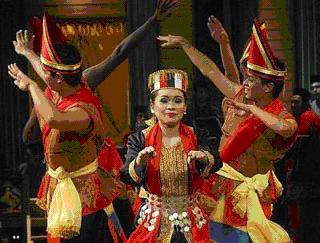 Rejang Be'uh. Pix source: The Star
 Adai-Adai was originally a Brunei folk song. It tells about life in the fishing villages, where the men leave early in the morning to earn their daily keep and the women folk await their return. Over the years, a new traditional dance has been created to accompany this folk song.
The highlight of the programme was the tari inai, a highly skilled folk form from Pasir Mas, Kelantan. It is a derivative of the mak yong and silat in movement, costume and music. The blare of the serunai (flute) and the delicate fingerwork are strong references to the mak yong tradition, while the swooping hand movements are culled from silat. Also unique in this item was how the dancers bent all the way back to pick up a piece.

Tari Inai. Px Source: The Star
Zapin Bunian, widely performed in Johor, takes its name from the area where it was developed – Kamping Sri Bunian in Pontian. The dance is thought to have been brought to Malaysia by Arab merchants in the 1500s and is synonymous with the spread of Islam. The unique movements of the torso, and the changing rhythms and dynamics of the dance and music make it one of the most exciting folk forms. Originally performed only by male dancers, zapin is now choreographed to accommodate male-female pairs, like in this piece.
Zapin Hanuman was inspired by the Ramayana. Infused with elements taken from the dances of the Middle East, this dance became popular in the 1970s through the work of choreographers such as Syed Hanasuddin and Yahya Abd Hamid. At Tapestry, this item was fast and vigorous – the dancers were practically running, and they performed many turns, hops, and little kicks. It was certainly a test of stamina for them.
The inang renek was choreographed by Wan Nor Mohammad Wan Alam and danced to the tune of Inang Tua. This must be the Malay version of Shakira’s Hips Don’t Lie. This cute and endearing piece saw the dancers take tiny little steps while shaking their hips regularly.
The production also featured two Indian and two Chinese dances.
Veteran classical Indian dancers Radha Shetty and Vatsala Sivadass guided the students in a stunning classical jatiswaram kalyani performance and a spear-bearing Assam dance. Jatiswaram is a pure dance section of the bharatanatyam repertoire, a classical Indian dance form, while Assam is a folk dance from the Indian state of Assam. The latter depicted village men hunting and women tending to their children and farming.
Zapin Hanuman was inspired by the Ramayana. Infused with elements taken from the dances of the Middle East, this dance became popular in the 1970s through the work of choreographers such as Syed Hanasuddin and Yahya Abd Hamid. At Tapestry, this item was fast and vigorous – the dancers were practically running, and they performed many turns, hops, and little kicks. It was certainly a test of stamina for them.
The inang renek was choreographed by Wan Nor Mohammad Wan Alam and danced to the tune of Inang Tua. This must be the Malay version of Shakira’s Hips Don’t Lie. This cute and endearing piece saw the dancers take tiny little steps while shaking their hips regularly.
The production also featured two Indian and two Chinese dances.
Veteran classical Indian dancers Radha Shetty and Vatsala Sivadass guided the students in a stunning classical jatiswaram kalyani performance and a spear-bearing Assam dance. Jatiswaram is a pure dance section of the bharatanatyam repertoire, a classical Indian dance form, while Assam is a folk dance from the Indian state of Assam. The latter depicted village men hunting and women tending to their children and farming.
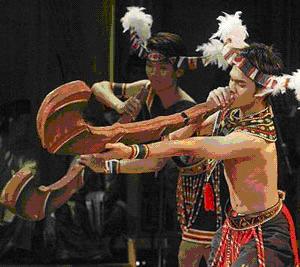
Assam Dance. Pix source: The Star.
Aswara lecturer Wong Kit Yaw choreographed the Chinese lantern and fan dances. Both pieces manipulated hand-held props to full effect. Wong always makes his work visually appealing; it felt as though I was watching a piece of art take life.
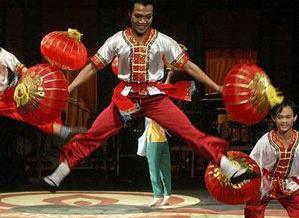 Lantern Dance. Pix Source: The Star.
 The performance concluded with joget, a folk dance form that is widely regarded as one of Malaysia’s national dances. It is similar to the branyo dance, which has Portuguese origins, due to its distinct time signature and the quick change of weight with the feet. Aris Kadir’s composition had a lively, cheeky quality and was performed by playful partners.
To sum up, Tapestry 2006 displayed the vibrancy of our cultural heritage and a celebration of unity in diversity.


Subscribe to:
Comments (Atom)